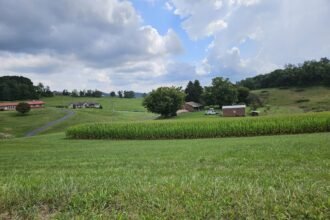
The topography of the Appalachian Highlands—characterized by steep grades, fragmented pastureland, and variable microclimates—has historically limited the efficiency of conventional mechanized agriculture.
However, the 2025–2026 agricultural technology cycle introduces three distinct innovations that decouple yield potential from terrain accessibility.
This technical review analyzes Virtual Fencing (VF), Heavy-Lift Unmanned Aerial Systems (UAS), and Autonomous Solar Robotics. We evaluate the manufacturer’s operational specifications, capital requirements, and funding pathways for producers in Southwest Virginia, Northeast Tennessee, and Northeast N. Carolina.

Virtual Fencing (VF) Systems
Technology Overview:
Virtual fencing replaces physical barriers with georeferenced boundaries managed via satellite. The system utilizes neck-mounted transponders (collars) equipped with GPS and LoRaWAN (Long Range Wide Area Network) connectivity.
When livestock approach a user-defined boundary, the collar emits an audio cue. If the animal persists, a benign electrical pulse is administered. This operant conditioning enables the farmer to train livestock to remain within their boundaries, thereby enabling dynamic rotational grazing without requiring physical infrastructure or labor.
Regional Application:
• Riparian Management: Precise exclusion of livestock from waterways (e.g., Holston River tributaries) to reduce erosion and comply with conservation mandates without erecting physical wire in flood zones.
• Slope Utilization: Facilitates high-density rotational grazing on gradients >20%, where installing T-posts is hazardous or cost-prohibitive.
Market Analysis & Specifications:
Gallagher (eShepherd) uses a base-station model. Best for producers already integrated into the Gallagher ecosystem.
Vence (Merck Animal Health): Focuses on herd management analytics. Optimized for larger bovine herds (100+ head).
Nofence: A Norwegian entrant now scaling in the U.S. Unique capability: offers collars sized for small ruminants (sheep/goats), essential for regional brush management.
Cost Structure:
• Hardware: $250–$300 per collar.
• SaaS (Software as a Service): $35–$50 per head/year.
• Infrastructure: LoRaWAN Base Stations range from $5,000–$10,000, depending on signal occlusion by terrain.
Financing & Adoption:
Producers should reference USDA-NRCS Conservation Practice Standard (CPS) 528 (Prescribed Grazing) when applying for EQIP funds. Regional NRCS offices are increasingly approving VF hardware as a cost-share item under management-intensive grazing protocols.

Heavy-Lift Unmanned Aerial Systems (UAS)
Technology Overview:
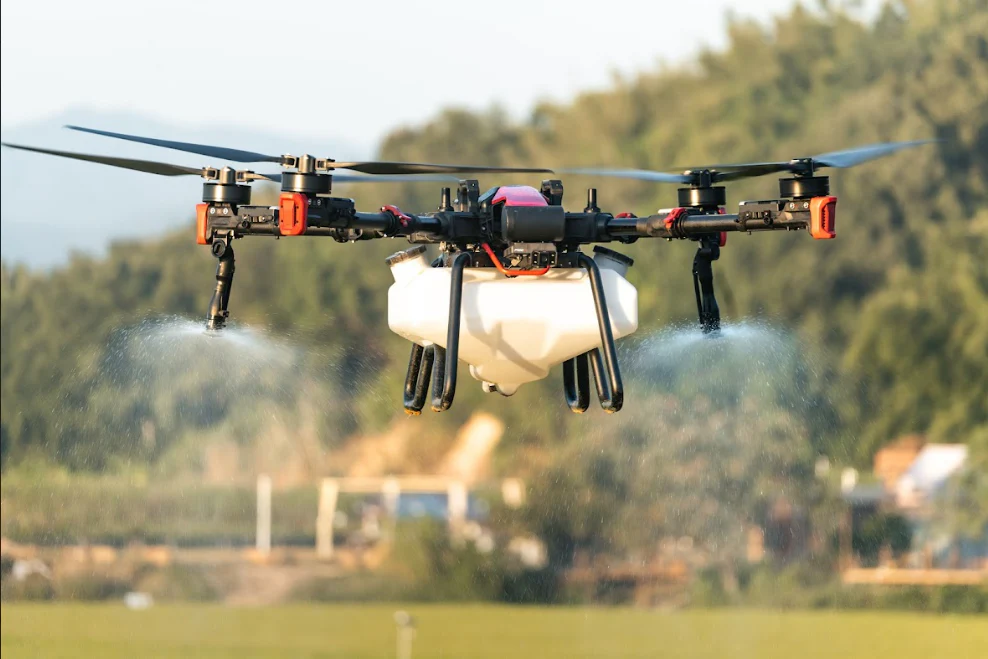
The 2025 generation of “Spray & Seed” drones has graduated from surveillance to payload delivery.
These heavy-lift hexacopters and quadcopters feature RTK (Real-Time Kinematic) positioning for centimeter-level accuracy and AI-powered spot-spraying systems that identify target foliage from cover crops.
Regional Application:
• Gully Stabilization: Aerial broadcasting of cover crop seed (clover, rye) into inaccessible washouts and gullies to reduce soil loss.
• Invasive Species Control: Targeted herbicide application on steep slopes for multiflora rose and ironweed control, eliminating tractor rollover risk.
Market Analysis & Specifications:
• DJI Agras T50: Industry standard. Payload capacity: ~50kg (solids) or ~10 gallons (fluids). Features omnidirectional obstacle avoidance.
• Hylio (AG-216 / AG-230): Texas-based. Notable for “swarm” software allowing one pilot to control multiple aircraft simultaneously.
• XAG (P100 Pro): Modular design allowing rapid swapping between spray tanks and seed hoppers.
Cost Structure:
• Airframe Only: $18,000–$25,000.
• Operational Kit: $30,000–$45,000 (Includes airframe, 4+ batteries, rapid-charging generator station, and controller).
Financing & Adoption:
• Tennessee: The Tennessee Ag Enhancement Program (TAEP) “Producer Diversification” module frequently covers precision ag technology at a 35–50% cost share.
• Renewable Integration: Utilizing solar-charged battery stations may qualify the purchase for USDA REAP (Rural Energy for America Program) grants.

Autonomous Solar Weeding Robotics
Technology Overview:
Unlike heavy tillage machinery, “slow robotics” utilizes lightweight, solar-powered platforms to perform mechanical weeding and seeding. These units operate continuously (24/7) at low speeds (<1 mph), using RTK-GPS to log the geocoordinates of every seed sown, enabling the robot to mechanically weed between plants in the row without computer-vision errors.
Regional Application:
• Soil Structure Preservation: With gross weights often under 2,000 lbs., these units eliminate soil compaction in the region’s clay-heavy valley bottoms.
• Organic Labor Substitution: Provides chemical-free weed control for row crops (peppers, beans, leafy greens) equivalent to a manual field crew.
Market Analysis & Specifications:
• FarmDroid (FD20): 100% solar (no grid charging required). Capable of seeding and weeding up to 15 acres. Zero fuel costs.
• Naïo Technologies (Oz): Smaller form factor suitable for market gardens (<5 acres). Functions as a weeding assistant and harvest transport.
Cost Structure:
• FarmDroid FD20: $75,000–$95,000 (Variation based on crop-specific seeding plates and freight).
• Naïo Oz: $15,000–$33,000.
Financing & Adoption:
• Virginia: Cooperative purchase by multiple growers can leverage the Governor’s Agriculture and Forestry Industries Development (AFID) Fund.
• Federal: NRCS Conservation Innovation Grants (CIG) are viable pathways, citing the technology’s ability to eliminate tillage and reduce herbicide loads.
Implementation Strategy:
For producers in the Appalachian Highlands, the barrier to entry is high capital expenditure (CapEx). However, the return on investment (ROI) is realized through labor reduction and the monetization of previously unfarmable acreage. We recommend producers consult their local Extension agents regarding the specific coding for EQIP and TAEP applications before procurement.
Heavy-Lift Drone Spec Sheet (2025–2026 Models)
| Feature | DJI Agras T50 | Hylio AG-230 | XAG P100 Pro |
| Best For | Steep Slopes & Speed Best-in-class obstacle avoidance and terrain following. | Large Flat Acreage The “Swarming” capability enables a single pilot to control multiple drones. | Versatility Modular design allows rapid swapping between spray & seed tanks. |
| Liquid Capacity | 40 Liters (~10.5 gal) (Payload: 40 kg) | 30 Liters (~8 gal) (Payload: ~38 kg) | 50 Liters (~13.2 gal) (Payload: 50 kg) |
| Spreader Capacity | 75 Liters (50 kg load) Accepts dry granules 0.5–5mm | 20–75 Liters (varies by tank) Max payload weight: ~110 lbs | 80 Liters (50 kg load) Vertical screw feeder for precision |
| Max Flow Rate | 16 L/min (2 nozzles) 24 L/min (4 nozzles) Magnetic drive impeller pumps | 11–15 L/min (3–4 gal/min) Uses standard TeeJet nozzles (easy to repair) | 22 L/min Peristaltic pumps (no contact with liquid, good for corrosive chems) |
| Spray Width (Swath) | 4–11 meters (13–36 ft) Depends on flight height | 6–9 meters (20–30 ft) Standard boom setup | 5–10 meters (16–33 ft) Dual centrifugal atomizers |
| Terrain Following | Excellent (50° Slope) Uses Phased Array Radar + Binocular Vision to hug steep hills. | Good Uses a radar altimeter; optimized for flatter runs but handles moderate hills. | Very Good 4D imaging radar rapidly detects obstacles and slope changes. |
| Battery & Charging | 9-Minute Fast Charge Air-cooled heat sink. 30,000 mAh battery. | 15–20 Min Charge Dual-channel charger. 2x 16Ah batteries per flight. | 11-Minute “Water-Cooled” Batteries charge in a water tank to prevent overheating. |
| Origin / Data Security | China (DJI) Check local restrictions for govt. use. | USA (Texas) NDAA Compliant. Preferred for federal/state grant projects. | China (XAG) Check local restrictions for govt. use. |
| Approx. Kit Cost | $30,000 – $45,000 (Includes drone, generator, 4 batteries) | $40,000 – $55,000+ (Premium US support & software) | $28,000 – $35,000 (Often slightly cheaper than DJI) |
Key Takeaways for Appalachian Farmers
• The “Slope King”: If your primary goal is spraying invasive weeds on steep, dangerous hillsides, the DJI Agras T50 is currently the leader. Its radar system is specifically designed to “climb” hills at a consistent height (terrain following up to 50°).
• The “Grant Friendly” Option: If you are applying for federal funding (like USDA grants) that requires NDAA Compliance (security rules against foreign tech), Hylio is the safest investment.
• The “Seeding Specialist”: If you plan to do a lot of cover crop seeding in gullies or washouts, the XAG P100 Pro is excellent because its spreading hopper is larger (80L) and swaps out in under 5 minutes without tools.

The Drone Buyer’s Checklist: What to Ask Before You Commit
Clip this and take it to your dealer or Extension office.
1. Regulatory & Legal Hardballs
Question: “Is this drone NDAA Compliant?”
Why ask: If you are using federal funding (USDA/NRCS), you often cannot purchase Chinese-made technology (DJI/XAG) due to data security bans. You need a US-made or “Blue UAS” approved drone (like Hylio).
Question: “Does the purchase price include assistance with FAA Part 137 licensing?”
Why ask: You already know you need a Part 107 (Remote Pilot Certificate) to fly. But to dispense any substance (even water or seeds) from a drone, you legally need a Part 137 Agricultural Aircraft Operator Certificate. This paperwork is complex; good dealers will handle it for you.
2. The “Appalachian Reality” Check
Question: “Does the obstacle avoidance radar work effectively on slopes greater than 20 degrees?”
Why ask: Many drones are programmed for the flat Midwest. In the Highlands, a drone that treats a steep hill as an “obstacle” will refuse to fly up it. You need “Terrain Following” capabilities.
Question: “Does the controller require an active cellular connection to fly missions?”
Why ask: If you are flying in a “holler” with zero cell service, you need a controller that stores maps locally. Ask if the system has an “Offline Mode.”
Question: “How does the Return-to-Home (RTH) function handle tree canopies?”
Why ask: If the battery runs low, the drone will return home autonomously. If it tries to fly in a straight line through a 50-foot oak tree, you lose $30k. Look for “Smart RTH” that traces the original flight path back.
3. Maintenance & Uptime
Question: “Where is the nearest authorized repair center, and do you stock crash kits?”
Why ask: You cannot wait 6 weeks for a propeller arm during spray season. If the dealer is based in Nebraska, ask whether they offer overnight shipping for parts.
Question: “Are the pumps peristaltic or impeller-based?”
Why ask: If you spray abrasive wettable powders (common in organic clay sprays) or thick fertilizers, impeller pumps can clog or wear out. Peristaltic pumps (which squeeze the tube) are better for thick/gritty mixes.
4. Power & Logistics
Question: “What is the generator’s fuel consumption rate per hour?”
Why ask: Fast-charging these massive batteries requires a heavy-duty gas generator (often included). You need to know how much gas to haul to the field.
Question: “Can the charger handle ‘dirty power’ from a PTO generator?”
Why ask: If you plan to charge the drone’s smart batteries from the tractor’s PTO instead of the drone’s dedicated generator, you must ensure that voltage fluctuations do not damage the smart batteries.