

Drought loans are available to qualifying farmers across the Appalachian Highlands.
This follows a series of USDA disaster designations affecting Virginia, Tennessee, Kentucky, West Virginia, and North Carolina.
But being in a designated county doesn’t guarantee financial assistance.
Farmers must document their losses, meet federal lending requirements, and show they can repay the money.
Farmers across the Appalachian Highlands can seek federal help for agricultural losses tied to the 2026 drought.
One option includes Drought loans for eligible losses.
But qualifying for that help involves more than having a farm in a disaster-declared county.
The U.S. Department of Agriculture has issued a series of drought disaster designations.
These designations also affect counties in Virginia, Tennessee, Kentucky, West Virginia, and North Carolina.
As a result, Drought loans may be available to affected counties.
The latest announcement, issued November 16, names Hawkins County, Tennessee, as a primary disaster area.
Grainger, Greene, Hamblen, Hancock, Sullivan, and Washington counties in Tennessee, along with Scott County, Virginia, are listed.
Additionally, these areas are contiguous for Drought loans.
Many of those counties were already eligible under earlier drought declarations. The November announcement establishes another designation covering the region.
In written responses to questions from Appalachian Highlands Farmers Magazine, a USDA spokesperson explained how the agency determines disaster eligibility, what farmers must demonstrate to receive assistance, and which programs might help producers who cannot afford additional debt.
A Disaster Declaration Doesn’t Establish Farm Losses
USDA’s fast-track drought disaster designations are based on conditions recorded by the U.S. Drought Monitor.
A county can qualify when any portion experiences severe drought, classified as D2, for eight consecutive weeks during the growing season. Extreme drought, classified as D3, or exceptional drought, classified as D4, can trigger a designation without the eight-week requirement.
The agency does not have to document agricultural production losses in each county before issuing a fast-track designation.
That means a county’s inclusion on the disaster list does not establish how many farms suffered losses or how much agricultural production was affected.
USDA directed Appalachian Highlands Farmers Magazine to the National Agricultural Statistics Service for agricultural production information and the U.S. Drought Monitor for historical comparisons.
The agency also clarified that improving weather conditions do not automatically eliminate eligibility.
“Improving conditions do not automatically reverse an existing disaster designation or eliminate eligibility for qualifying earlier losses,” the USDA spokesperson said.
Farmers who experienced losses during the growing season may therefore remain eligible even if rainfall has improved conditions since the original designation.
Which Counties Are Eligible for Drought Loans?
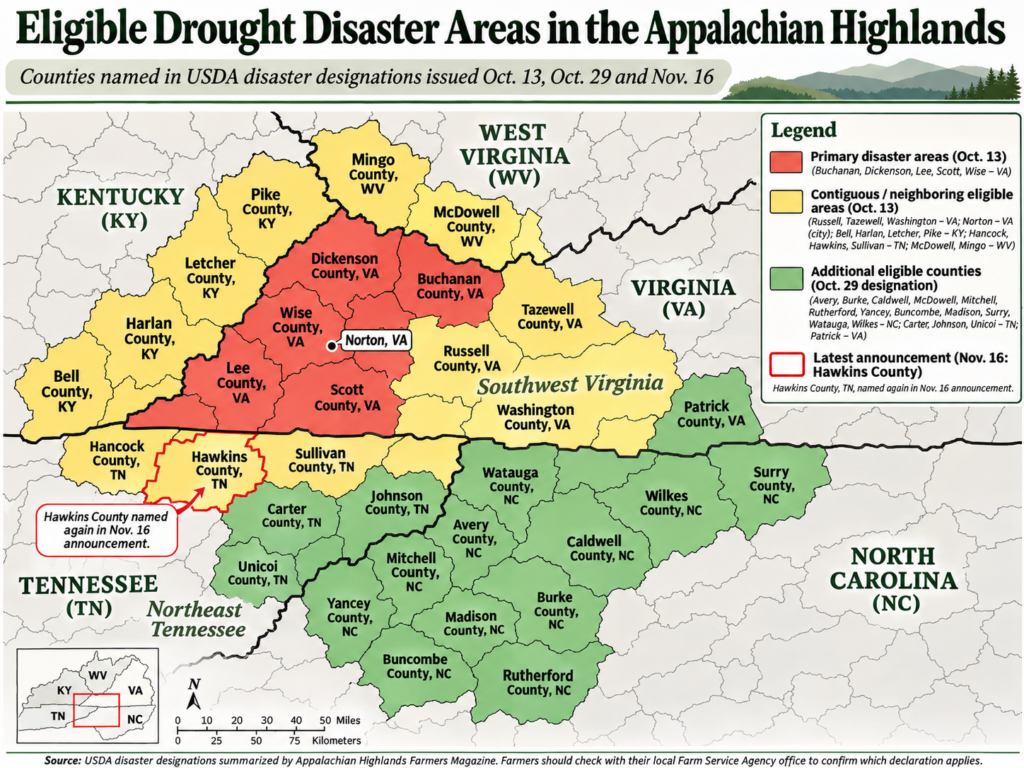
The October 13 disaster announcement included Buchanan, Dickenson, Lee, Scott and Wise counties in Southwest Virginia among its primary disaster areas.
Neighboring Russell, Tazewell and Washington counties, along with the city of Norton, were included as contiguous areas.
The same designation extended eligibility to Bell, Harlan, Letcher and Pike counties in Kentucky; Hancock, Hawkins and Sullivan counties in Tennessee; and McDowell and Mingo counties in West Virginia.
A separate designation issued October 29 included 13 North Carolina counties, among them Avery, Burke, Caldwell, McDowell, Mitchell, Rutherford and Yancey.
Additional eligible areas included Buncombe, Madison, Surry, Watauga and Wilkes counties in North Carolina; Carter, Johnson and Unicoi counties in Tennessee; and Patrick County in Virginia.
The November 16 designation naming Hawkins County is the latest of these announcements affecting the magazine’s Northeast Tennessee coverage area.
Farmers should check with their local Farm Service Agency office to determine which declaration applies to their operation.
Emergency Drought Loans Are Not Grants
The disaster designations allow eligible producers to apply for emergency loans through USDA’s Farm Service Agency, commonly called FSA.
The loans may help farmers replace essential equipment or livestock, cover certain production expenses, reorganize their operations, or refinance eligible debts.
Unlike grants, emergency loans must be repaid. USDA has set the interest rate at 3.75% for November 2026, and farmers can apply for loans of up to $500,000.
How much a farmer can borrow depends on the losses documented and the money needed to recover. FSA also considers whether the farmer can afford the payments, along with existing financial obligations and available collateral.
Applicants generally must demonstrate that they cannot obtain sufficient commercial credit to meet their disaster-related needs.
Existing farm debt does not automatically disqualify a producer, USDA said. However, those obligations become part of the agency’s financial review.
Repayment terms vary according to the type of loss and the circumstances of the farming operation.
Can Small Farms and Farmers Market Growers Apply?
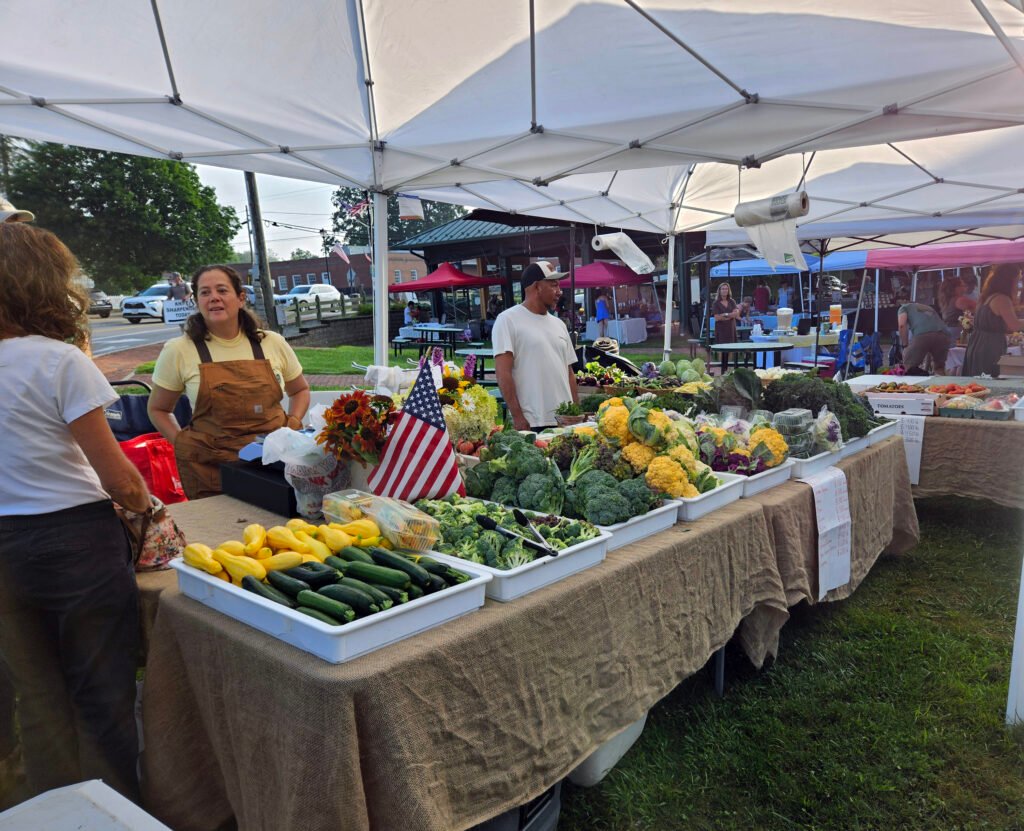
USDA confirmed that it does not automatically exclude smaller farms from emergency loan assistance.
“Farm size and marketing methods do not independently determine eligibility,” the agency spokesperson said.
That means farmers selling primarily through farmers markets, running smaller agricultural businesses, or entering farming for the first time may qualify if they meet the applicable requirements.
Applicants must still document qualifying disaster-related losses and satisfy FSA’s lending standards.
USDA also emphasized the difference between the conditions that trigger a geographic disaster designation and those used to evaluate an individual farmer’s loan application.
For certain production-loss-based designations, a loss of at least 30% in a primary crop is generally required. Fast-track drought designations, however, are triggered by Drought Monitor conditions rather than those county-level production assessments.
Farmers should ask FSA which loss documentation and eligibility standards apply to their particular application.
Other Assistance May Be Available
For farmers already struggling financially, borrowing more money may not be the best solution.
USDA identified several programs that may assist without requiring the producer to take on another emergency loan.
The Livestock Forage Disaster Program can assist qualifying livestock producers who experience grazing losses because of drought.
The Emergency Assistance for Livestock, Honeybees and Farm-Raised Fish Program may help eligible producers with certain extraordinary costs or losses, including additional expenses for transporting feed or water.
The Noninsured Crop Disaster Assistance Program protects qualifying crops that lack access to conventional federal crop insurance.
Other programs include the Emergency Conservation Program and Tree Assistance Program.
USDA’s Natural Resources Conservation Service also offers assistance through programs such as the Environmental Quality Incentives Program and Conservation Stewardship Program.
Not all these programs require a federal disaster designation, and each has separate eligibility rules.
The USDA spokesperson emphasized that assistance programs providing financial payments generally do not require repayment, unlike emergency loans.
Farmers should not assume that qualifying for one program automatically makes them eligible for another.
What Farmers Need to Apply
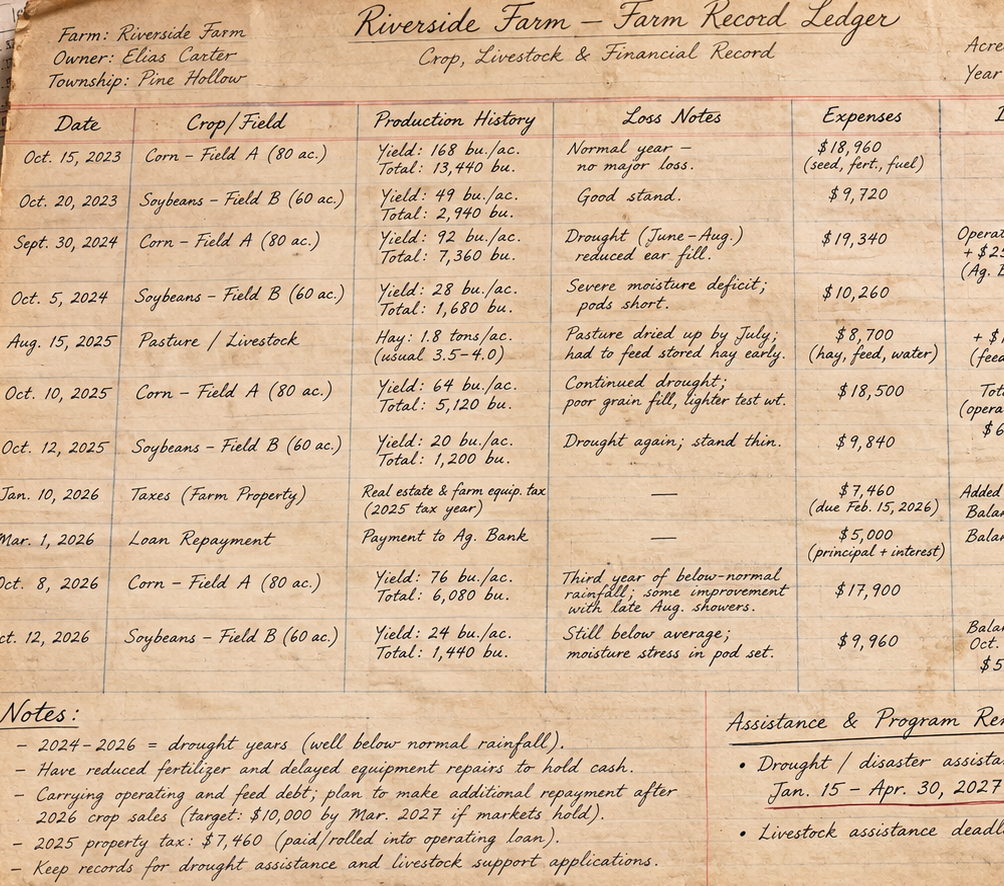
USDA recommends that farmers begin gathering records before contacting FSA.
Those records may include crop production histories, evidence of drought-related losses, financial statements, tax returns, information about existing debts, and applicable crop insurance documentation.
Historical production records are particularly important because they help establish how a farm performed under normal conditions.
The agency identified incomplete financial information, difficulties documenting losses, and questions about repayment ability as potential obstacles in the application process.
Processing times vary depending on each application’s completeness and complexity.
USDA also said it is too early to determine how many producers in the newly designated counties will apply or receive emergency loans.
The application window generally remains open for eight months following a disaster designation.
Some other programs have different deadlines. For example, applications for certain livestock assistance programs covering 2026 losses are due March 1, 2027.
Application Deadlines Vary
The October and November disaster declarations have different application deadlines.
For the October 13 Virginia designation, the emergency loan deadline is May 10, 2027.
The October 29 North Carolina designation carries a deadline of June 21, 2027.
The November 16 designation naming Hawkins County, Tennessee, also lists May 10, 2027.
Other declarations issued earlier in 2026 may have different deadlines, including those covering some of the same counties.
Farmers should confirm the applicable deadline with their local FSA office rather than relying on the most recent announcement date.
Planning for Future Droughts
USDA also encourages farmers to consider conservation measures that could reduce their vulnerability to future droughts.
The agency identified water management, soil health, and agricultural conservation practices as areas where technical and financial assistance may be available.
Programs administered through FSA and the Natural Resources Conservation Service can help qualifying producers investigate conservation improvements.
However, drought affects farms differently depending on soil conditions, topography, water availability, and production practices.
A practice that benefits one operation may be impractical or less effective on another.
Farmers interested in conservation assistance should discuss their operation’s circumstances with local USDA personnel.
Where Farmers Should Start
For agricultural producers who believe drought affected their operations in 2026, USDA recommends contacting the nearest USDA Service Center.
Local FSA personnel can explain which disaster designations apply, help identify available assistance, and review the documentation needed to begin an application.
Farmers can also use the Disaster Assistance Discovery Tool and Loan Assistance Tool available through farmers.gov.
The tools guide programs that may apply to particular types of losses and farming operations.
The USDA spokesperson stressed that a disaster designation establishes an opportunity to seek assistance, not a guarantee of receiving it.
For farmers facing another growing season after drought-related losses, understanding that difference — and identifying assistance that fits their financial circumstances — may be an important part of planning for 2027.
For assistance: Visit farmers.gov/service-center-locator to find a local USDA Service Center. Additional program information is available at farmers.gov and fsa.usda.gov.
Front Page









Leave a Reply