

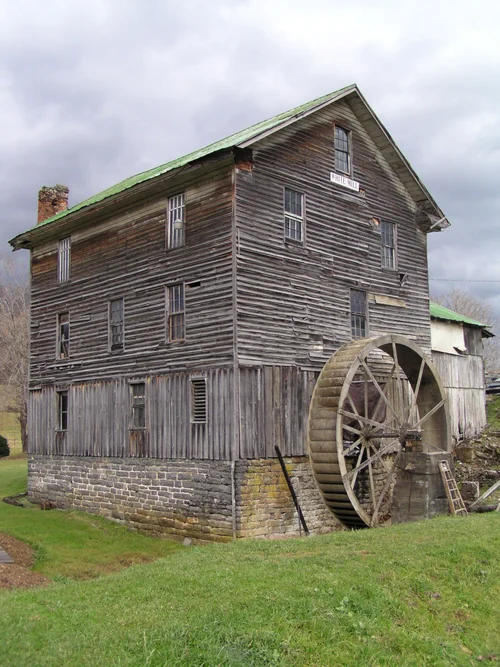
Water spilling into White’s Mill’s 20-foot wheel sends a shaft turning through the wall. Inside, that motion once drove gears, belts, millstones, and grain elevators across three floors. Preserving the mill means keeping that chain of machinery — and the knowledge needed to operate it — alive.
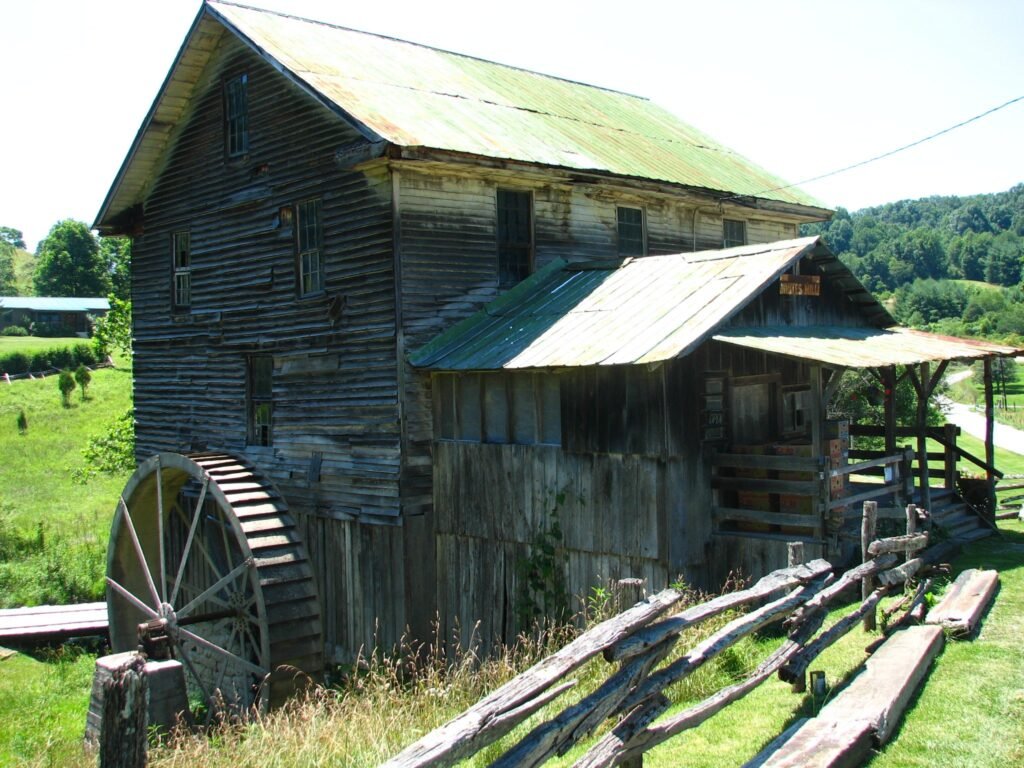
Outside White’s Mill, the 20-foot waterwheel commands attention. The metal wheel rises beside the weathered building on Toole Creek, offering visitors an immediate symbol of an earlier age.
But the wheel only starts the process. The building itself forms the real machine.
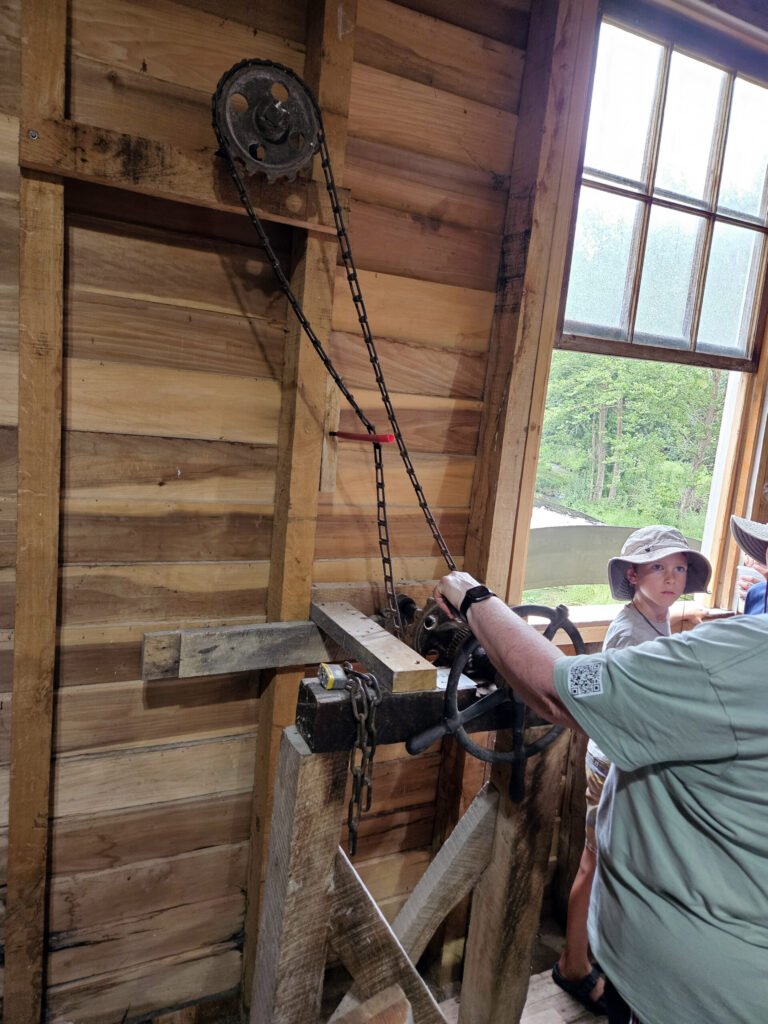
The ring gear looked as if it would take several people to move. Coley Houser gave it a push, and the massive wheel rolled under his hand.
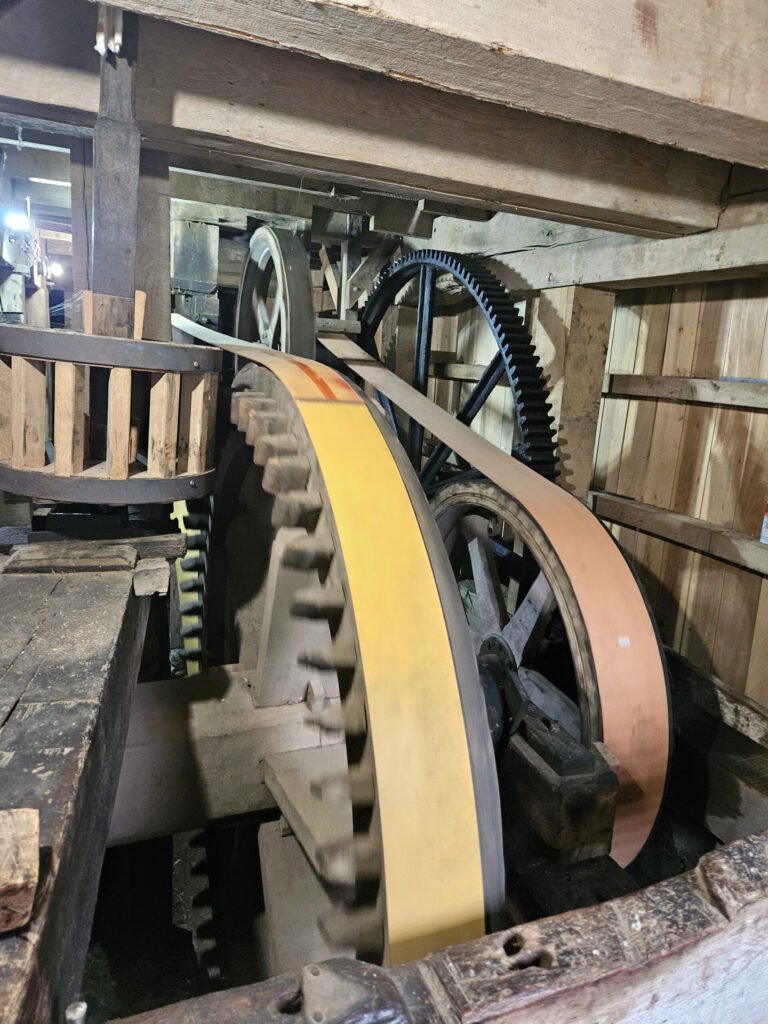
“They’re really well-balanced,” he said.
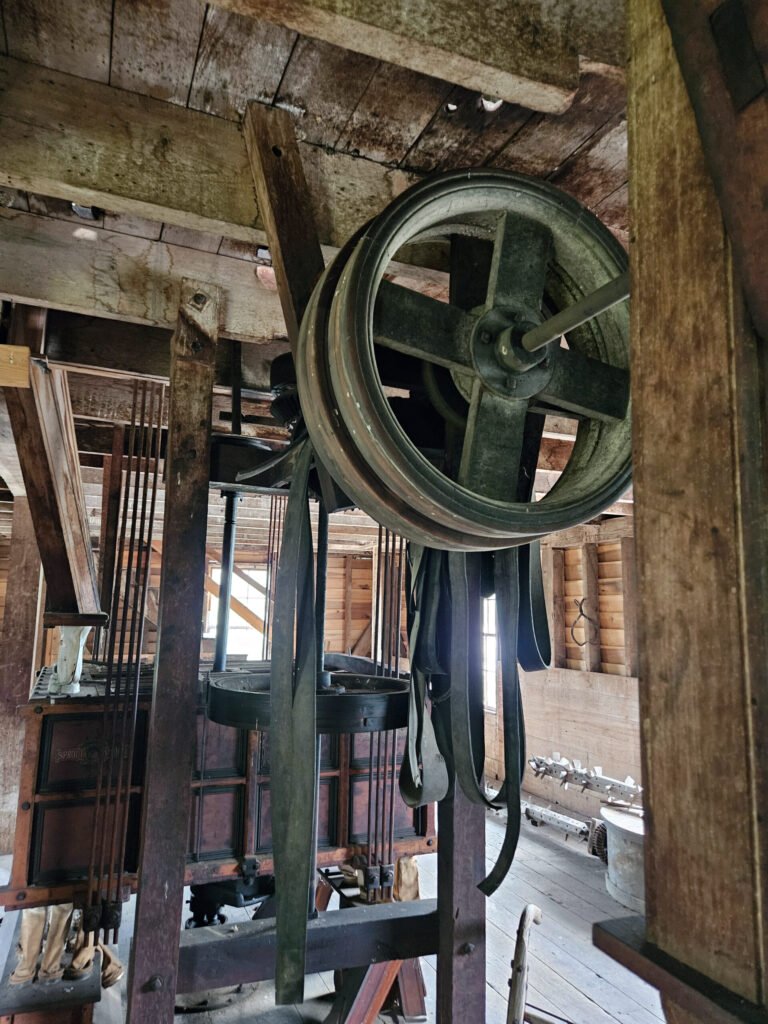
Just beyond the stone wall stood the waterwheel; overhead, bare shafts and pulleys marked the routes once followed by leather belts to the upper floors.
From the outside, White’s Mill looks like a picturesque survivor from rural Virginia. From the basement, it looks like a manufacturing facility.
Its builders confronted many of the same problems manufacturers still face: how to generate power, transmit it efficiently, move raw material through a sequence of operations, control production flow, separate products by grade and protect a building from the machinery inside it.
They solved those problems without electricity, electronic sensors or programmable controllers. They used water, gravity, wood, iron, leather, canvas and an ingenious arrangement of mechanical systems.
An early automated plant
Milling began at this site in the narrow valley of Toole Creek during the 1790s. Research assembled for this article identifies John Lewark, also spelled Luark, as the millwright who constructed an early water-powered mill for Thomas Moffett. The Virginia Department of Historic Resources dates Moffett’s establishment of a mill at the site to about 1797.
That first operation should not be confused with the building that stands today. The department says Col. James White acquired the property in 1838 and his son, William Y.C. White, built the present mill about 1840. The White family’s long association with the property gave the mill the name it still carries.
The building visitors see today dates to about 1840, decades after milling began on Toole Creek. Later owners kept it useful by repairing the structure and adding newer equipment as milling technology changed.
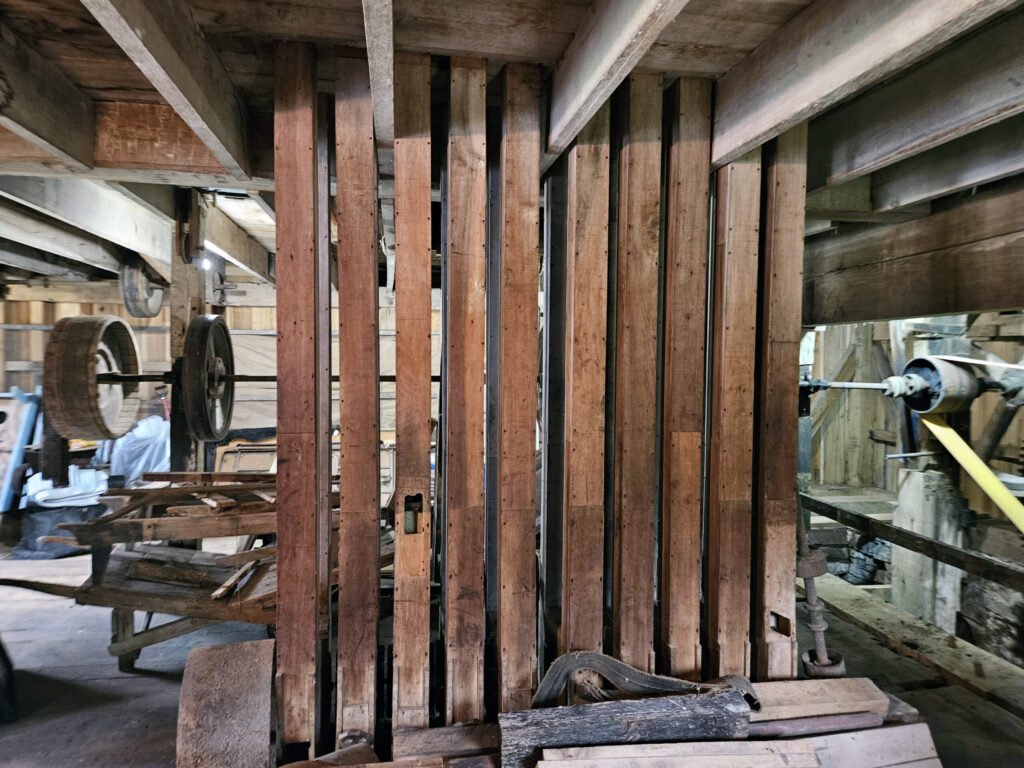
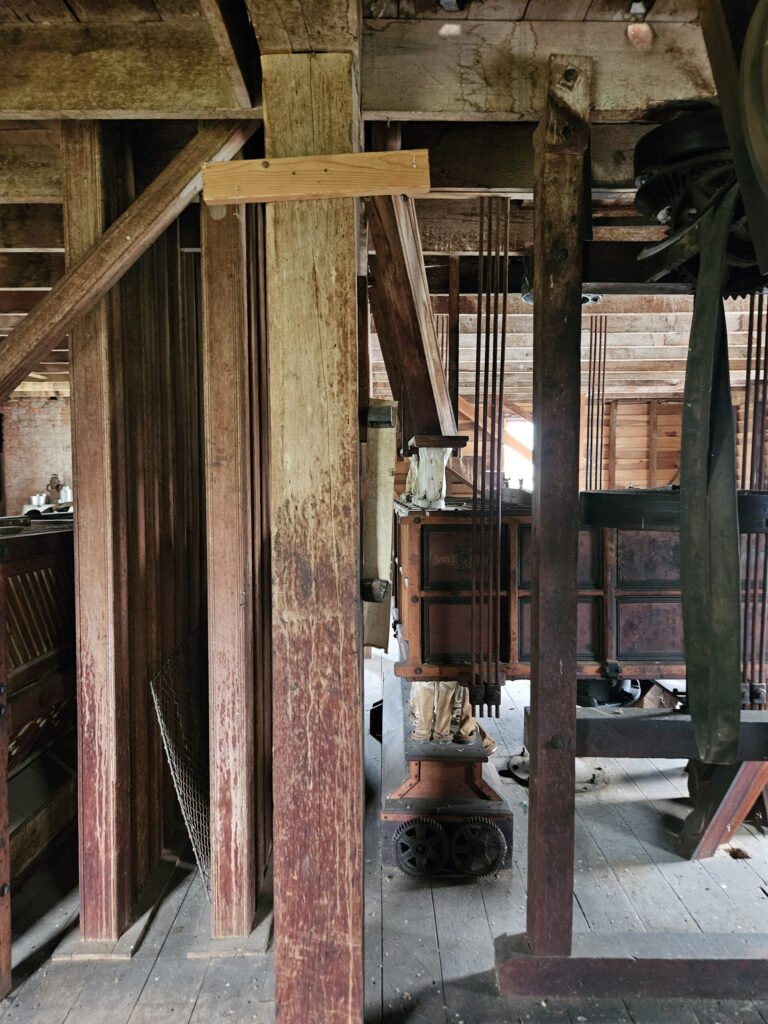
By the time the present mill went up about 1840, millers had learned to make the building do much of the lifting. Oliver Evans had described the basic system decades earlier in “The Young Mill-wright and Miller’s Guide.” Grain elevators raised the product from floor to floor, while chutes let gravity carry it back down to the next machine. Virginia historic records identify White’s Mill as a surviving example of that approach.
One elevator vanished into the floor above. Houser said a belt inside carried small buckets of grain upward; the chute beside it brought the grain back down. I spent years around conveyors, and this was the same old problem — move material without paying someone to carry it — solved with wood, leather and gravity.
The miller did not simply operate a pair of stones. He supervised a production line.
A custom-processing business
Houser, who led a detailed tour of the machinery, began not with the wheel but with the customer.
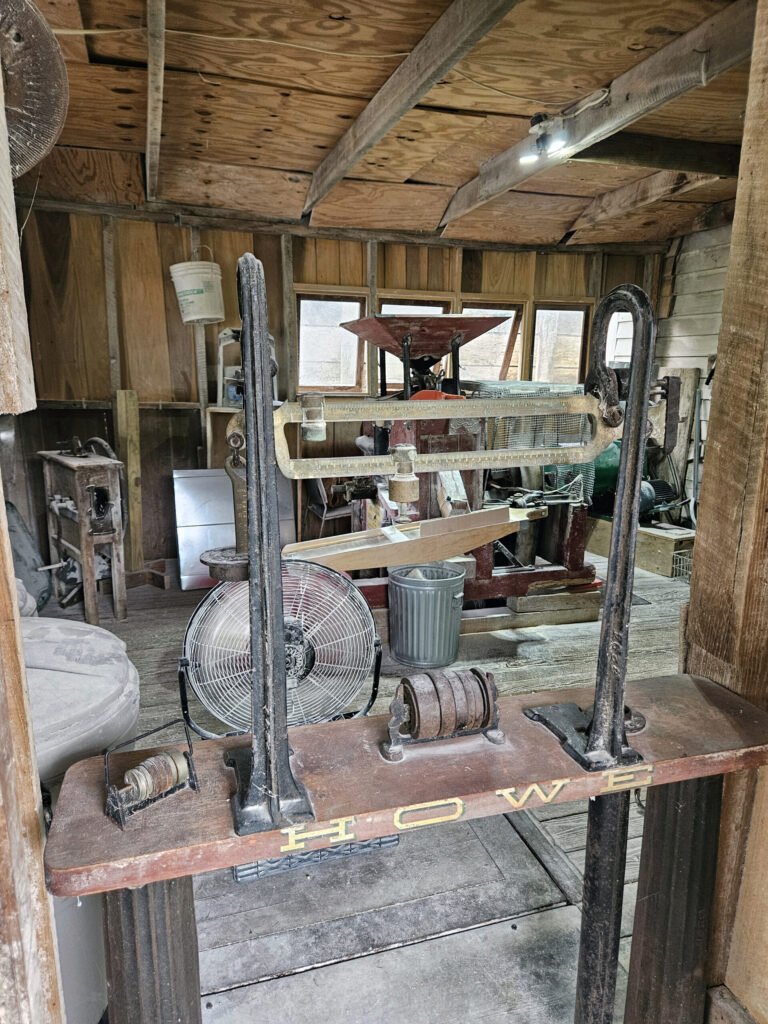
A farmer would arrive with corn or wheat and meet the miller. The miller would weigh the grain, and the two would settle on compensation. Houser said the miller usually took a toll — a portion of the grain — in exchange for processing it. Local or state regulations could govern the permitted amount.
The arrangement worked much like job-shop production. A farmer brought in his own corn or wheat, and the miller weighed it, processed it, and returned the finished meal or flour, keeping a portion as payment.
Houser divided the room with a gesture. Corn went to the stones on one side; wheat moved through the equipment on the other. The mill handled both grains under one roof, but not in the same way.
From corn to meal
For corn, the process began at a hopper above the millstones. The hopper did not dump the grain into the machinery all at once. It fed the corn through a smaller regulating device called a shoe, which controlled the rate at which kernels entered the stones.
Houser explained that the upper stone, called the runner stone, turned while the lower bed stone remained stationary. Furrows cut into the faces of both stones drew the kernels outward from the center and ground them progressively finer. By the time the material reached the outer edge, whole kernels had become meal.
That operation only began the process
The ground corn dropped through the floor into the bottom of an elevator. Inside its wooden housing, a continuous belt carried a series of small buckets. Each bucket scooped up part of the product, lifted it to another level, and emptied it into a chute.
The chute then carried the material into a sifter or bolter, which separated coarser grits from finer cornmeal.
The elevators eliminated much of the lifting workers otherwise would have done by hand. They also allowed the mill to use the full height of the building. Mechanical power raised the material, and gravity carried it through cleaning, grinding, sifting, and storage operations.
Together, powered elevation and gravity-fed descent formed the mill’s material-handling system.
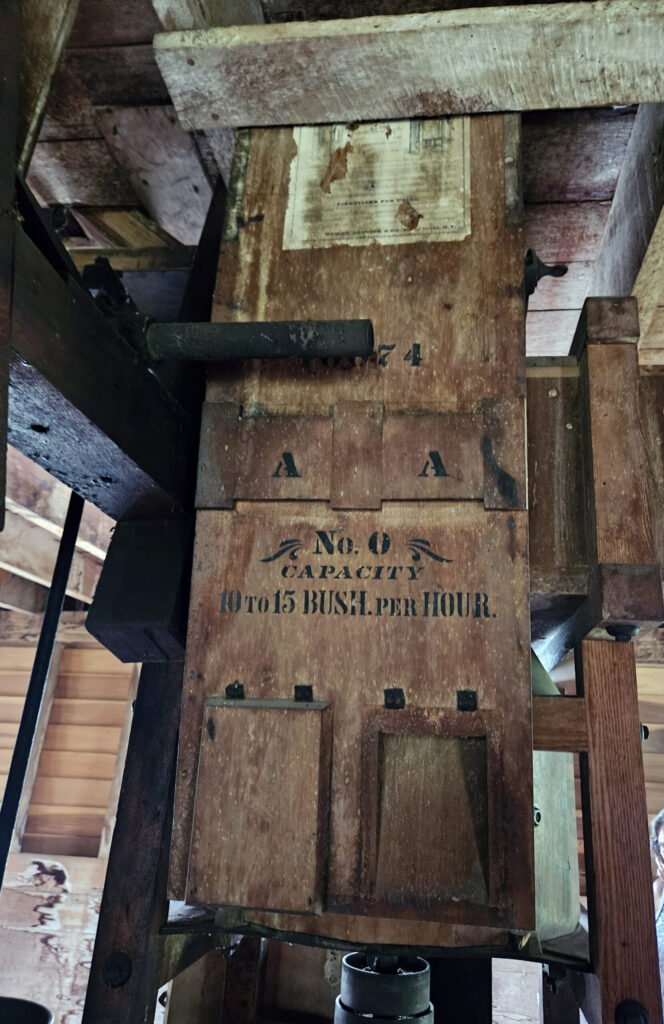
Separating Machine cleaned the grain
Following the wheat
Wheat followed a more elaborate route
Houser traced its path through the building. Workers poured raw wheat through an opening in the floor. A bucket elevator carried it upward for cleaning. The grain then descended to the grinding equipment, traveled upward again for sifting and grading, and finally dropped into bins for storage or bagging.
“Everything comes down and then goes up, down and back up,” Houser said as he followed the elevator housings through the mill. “It makes two trips.”
His description captures the mill’s operating logic. Grain did not move along a straight, horizontal production line. Instead, the building became part of the conveying system. Floors, shafts, chutes, and bins created a vertical process layout in which machinery repeatedly raised the grain and gravity brought it back down.
“Some of these are moving the grain before it’s ground, and some are moving after it,” Houser said. One elevator lifted dirty wheat to the cleaner. Another carried the ground product back to the sifters, where the different grades dropped into bins below.
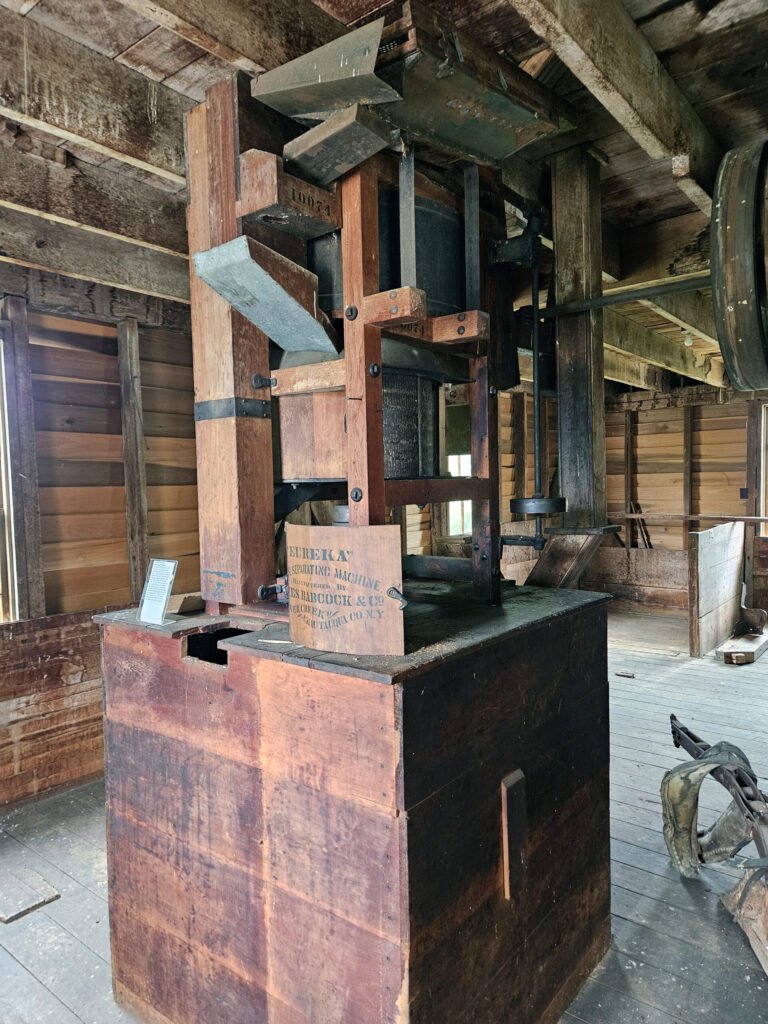
The surviving equipment fills in the route Houser described. A placard beside the Eureka Smut and Separating Machine says dirty wheat entered from a sink beneath a trap door on the first floor. The first grain elevator carried it to cleaners above. Those machines blew chaff and other debris outside through openings in the weatherboards, then sent the cleaned wheat down square wooden tubes to the first roller mill.
From millstones to roller mills
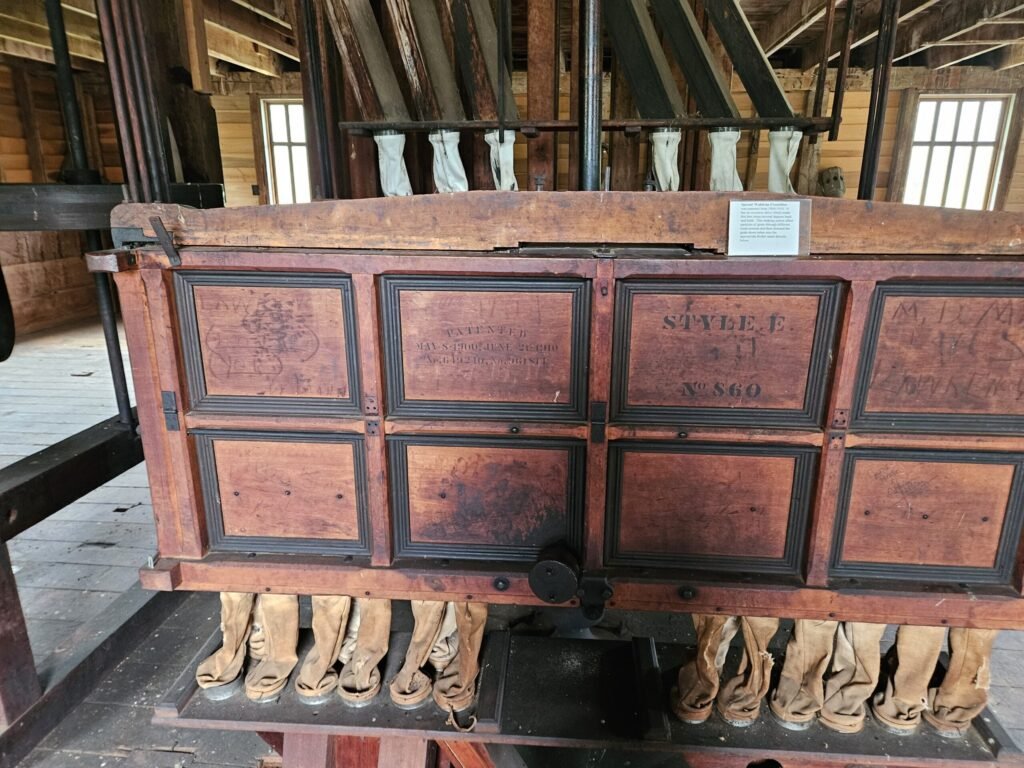
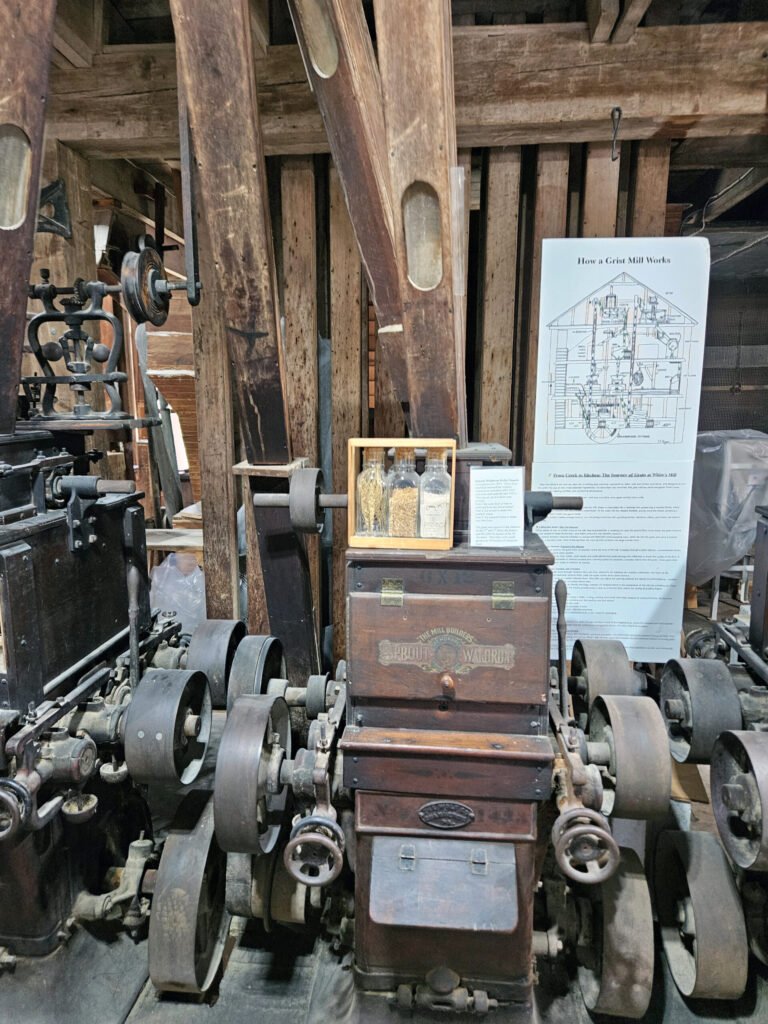
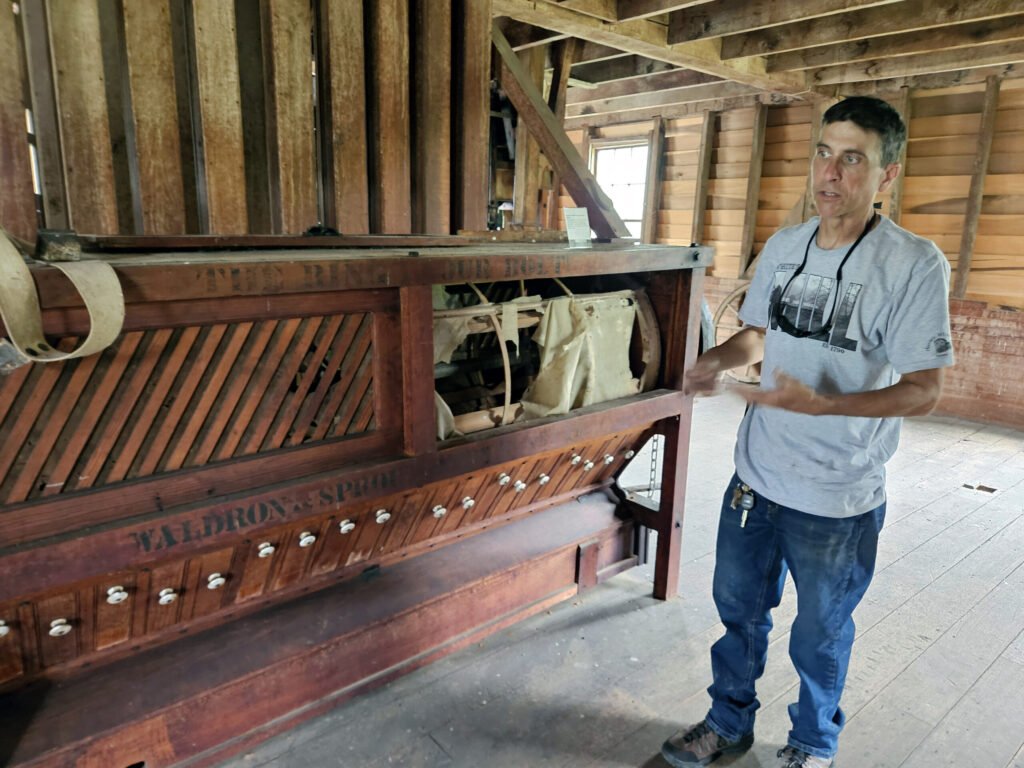
The roller mills represented a later generation of technology. According to another display at the mill, three Sprout Waldron roller stands replaced the original wheat-grinding stone sometime after 1910 and remained in use until the late 1950s.
The display describes a three-step process. The first stage removed the outer bran from the wheat kernel. The second stage reduced the kernel to cracked wheat. The third stage ground the cracked wheat into fine flour.
Moving all of that grain through the building required 10 elevators. The mill’s display says they carried grain among cleaners on the second and third floors, the shaker, and the sifter. The roller mills could process more than 10 bushels of wheat an hour.
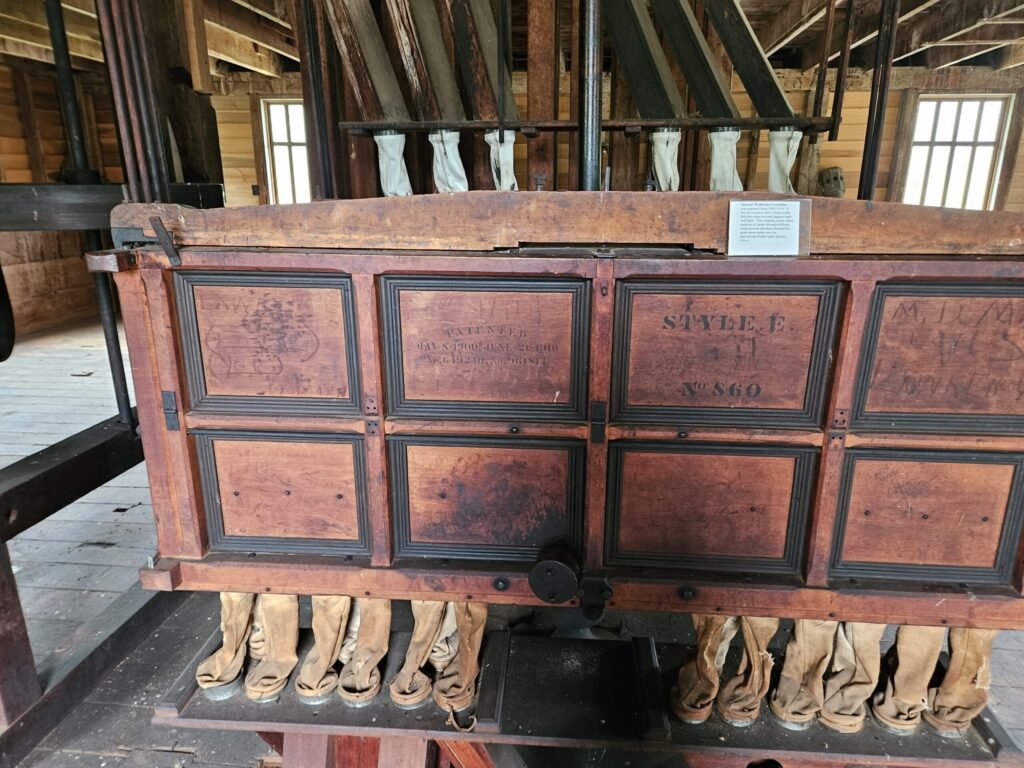
A surviving Sprout Waldron plansifter shows how the mill sorted material between passes. An eccentric drive shook the material across screens of different sizes, and tubes directed the separated product toward the appropriate roller mill below. Patent markings on the machine list dates of May 8, 1900, and June 21, 1910.
White’s Mill did not discard the old equipment when roller milling arrived. The millstones remained in place while later owners added shafts, belts, and roller machinery to produce the finer, whiter flour customers had come to prefer.
The Virginia Department of Historic Resources describes the surviving combination of millstones, rollers, elevators, and sifters as evidence of the technological evolution of gristmilling.
Nothing had been swept away to make room for the rollers. The old stones were still there, and Houser could follow the added shafts and belts that connected the newer equipment to the mill’s existing drive.
Power through the wall
One external energy source powered the mill.
White’s Mill uses an overshot waterwheel, which receives water near the top. Water fills compartments around the wheel, and its weight pulls one side downward. The current 20-foot metal Fitz wheel replaced an earlier wooden wheel, although state records do not give a precise installation date.
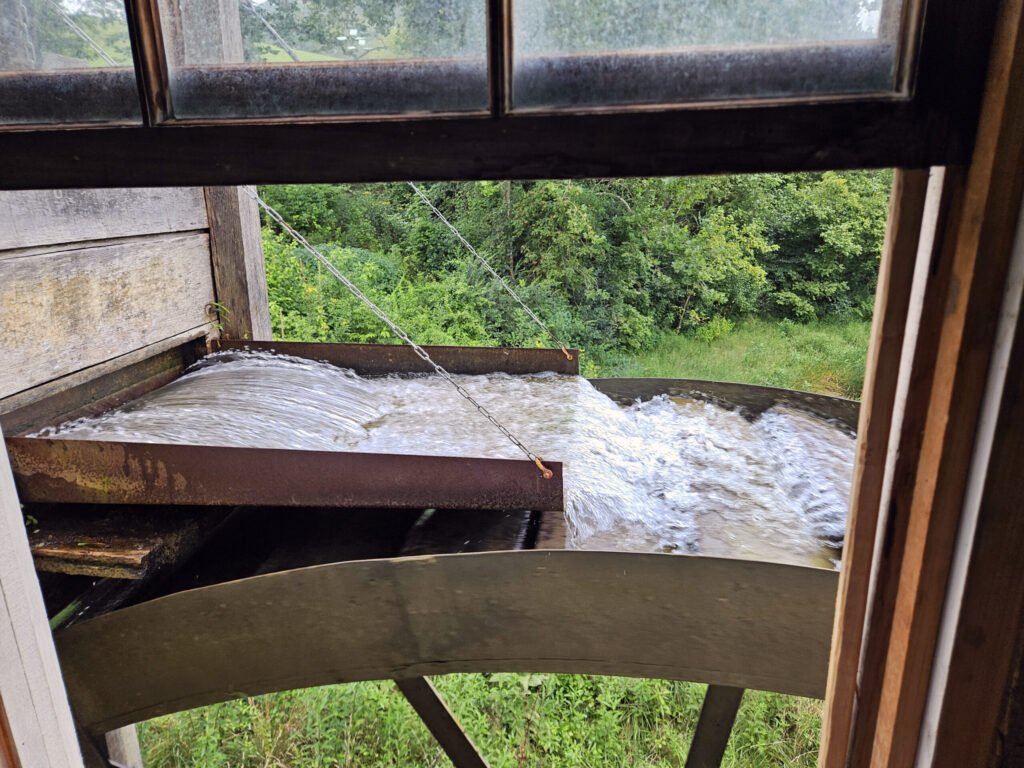
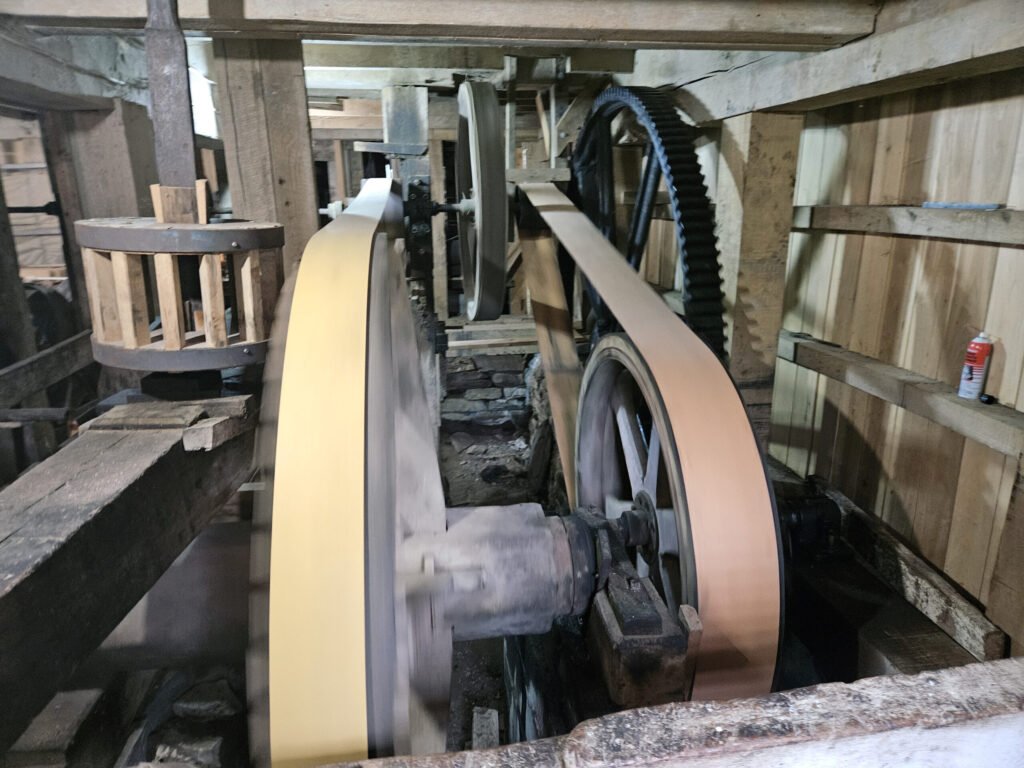
The wheel’s axle passes through the wall and carries the rotation into the basement. Houser pointed out the large ring gear and the smaller pinion that it drove. Their size difference changed the rotational speed, while shafts and pulleys transmitted motion to other parts of the mill.
The demonstration emphasized the equipment’s scale. These wheels did not serve as decoration. They transmitted enough power to drive stones, elevators, sifters, and other processing machines.
Houser showed how a miller could engage a drive to turn the corn stone. After the stones ground the corn, the meal would drop into an elevator and return to an upper level, where equipment separated it into cornmeal and grits.
Controlling the machinery
“You didn’t have to run all of it at one time,” Houser said. The miller could slip a belt from one machine or release its tension with an idler pulley while the main drive continued to turn.
That selective engagement served as the mechanical equivalent of switching individual motors on and off. Instead of electrical controls, the mill relied on belt position, pulley alignment, mechanical tension and the operator’s judgment.
The miller also had to balance capacity across the system. Elevators, sifters and grinders could handle only a limited volume. Houser said the operator had to feed each component at a rate it could manage. Too much grain would back up and bind the machinery.
Anyone who has dealt with a blocked conveyor, overloaded machine, or starved downstream process would recognize the problem. The mill produced reliably only when the operator balanced each stage against the next.
Protecting the building from the machine
Heavy rotating machinery creates vibration.
The stones, gears, and shafts could not simply rest on an ordinary wooden floor. Their weight and repeated motion would have shaken the building, loosened joints, and eventually damaged the structure.
White’s Mill addressed that problem with a Hurst frame, a heavy internal timber structure supported separately from the exterior walls. Houser described it as almost “a different building” inside the mill. The inner structure carried the machinery’s weight and vibration rather than transferring those forces directly to the outside walls.
The Hurst frame served as the mill’s machine foundation. Modern factories may place heavy equipment on isolated concrete pads, vibration mounts, or engineered steel supports. White’s Mill used massive timbers and a separate foundation to accomplish the same goal.
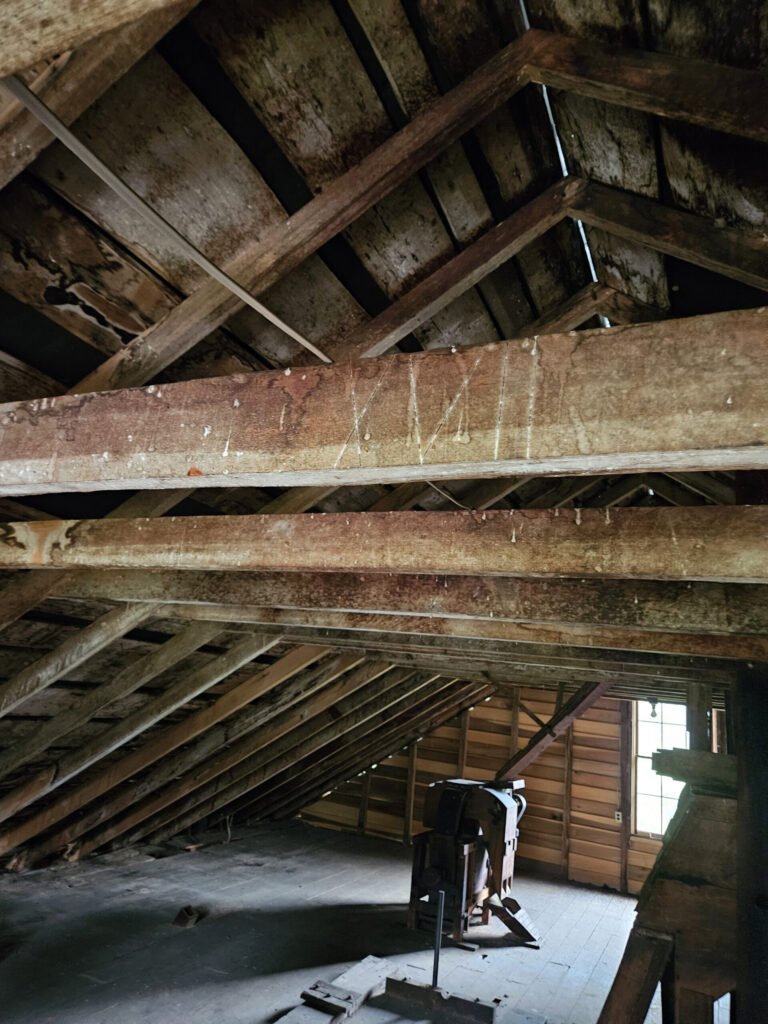
Builders left another clue in the upper framing: They carved the Roman numeral XVII directly into one timber. Similar marks appear elsewhere in the framing.
Houser identified them as carpenter’s marks. He said craftsmen could lay out and fit the heavy timbers before raising them, mark corresponding pieces, and then use the numbers to put each joint back together in the proper place.
A modern shop might identify fabricated parts with numbers on a drawing or match marks made before disassembly. Here, the builders cut the identification directly into the timber.
A plant that kept changing
State historic records say White’s Mill remained in regular use into the late 20th century. That longevity required adaptation.
Roller mills represented one major upgrade. Portable burr mills reflected another shift in the economics of grain processing.
Houser showed visitors an open portable mill that arranged its grinding surfaces vertically rather than horizontally. Farmers could operate such machines in barns or on farms and power them with tractors, engines, or other available sources.
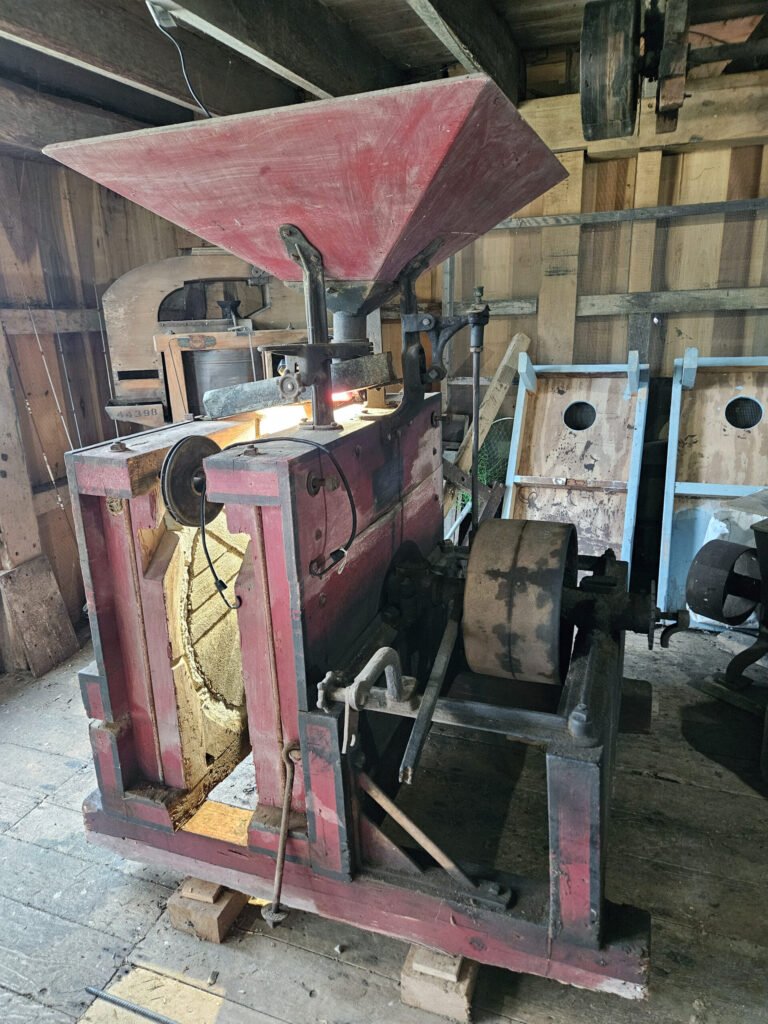
“Portable” remained a relative term. The machines still weighed a great deal, but they allowed operators to move grain processing closer to the farm. They reduced farmers’ dependence on large, centralized, water-powered mills.
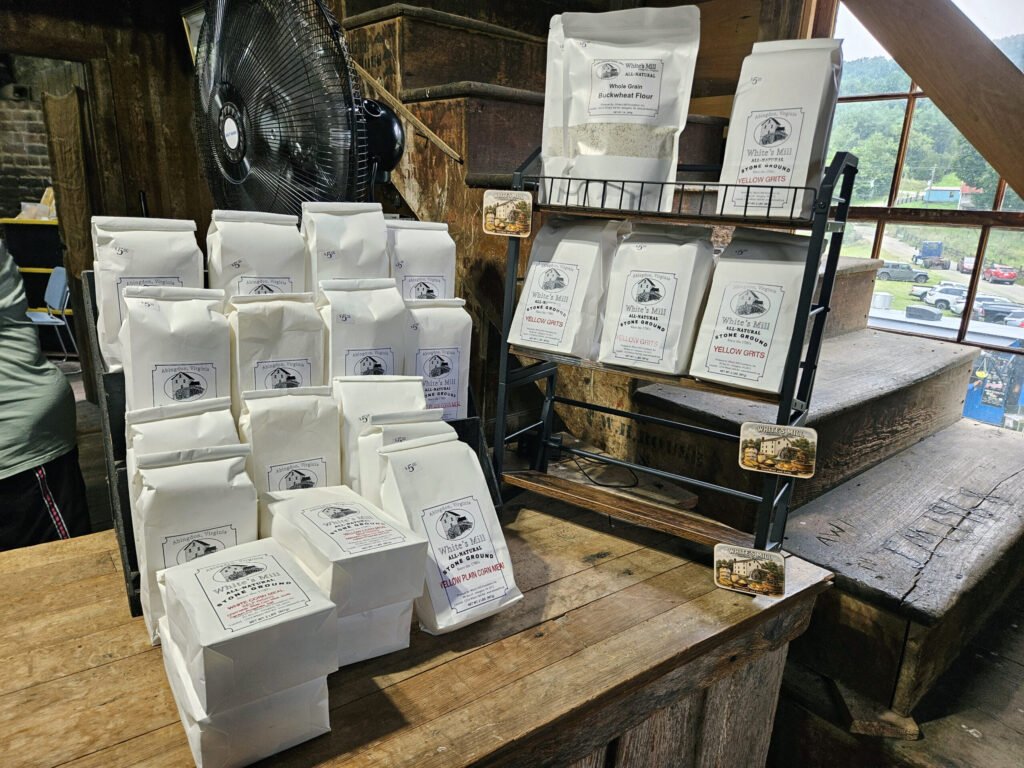
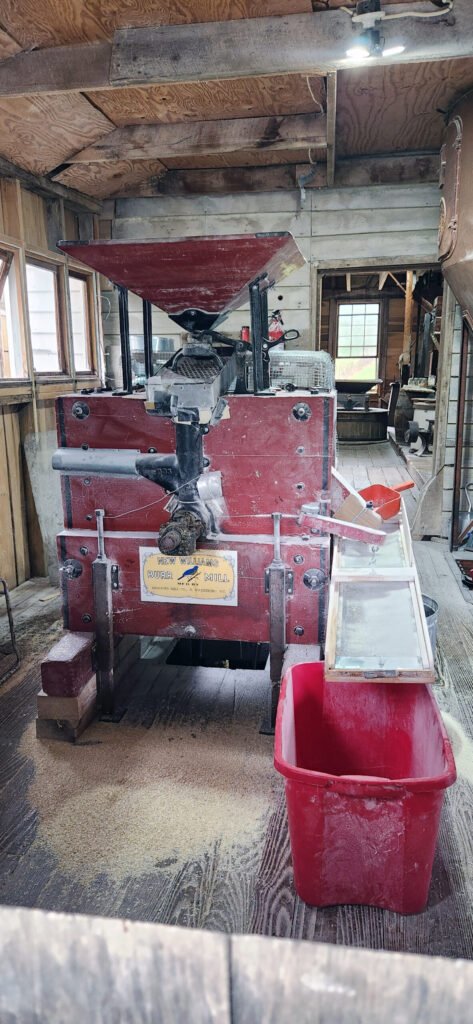
White’s Mill now keeps a smaller Meadows Mill Co. burr mill driven by electricity. Board member Ann McConnell said the mill has used that machine for its current grinding, and Houser also identified the upstairs grinding mill as electrically powered.
That adaptation does not diminish the historic water system. It continues the same pattern of practical change that sustained the mill throughout its working life.
The White’s Mill Foundation says restoration work returned the water system, gearing, and corn stone to operating capability. Visitors can watch the waterwheel and drive machinery turn, while the electric burr mill offers a smaller and more manageable way to produce meal.
The phrase “operating mill” can describe several conditions: a turning waterwheel, functioning power-transmission equipment, an engaged historic corn stone, or routine production of meal for sale. White’s Mill preserves parts of all those stories, but they do not necessarily occur during the same production run.
History, evidence and tradition
Like many old industrial sites, White’s Mill carries stories that people can repeat more easily than researchers can document.
McConnell said Union forces under General George Stoneman damaged the mill during the Civil War, destroyed its wooden wheel, and burned part of the building. She said rebuilding began in 1866.
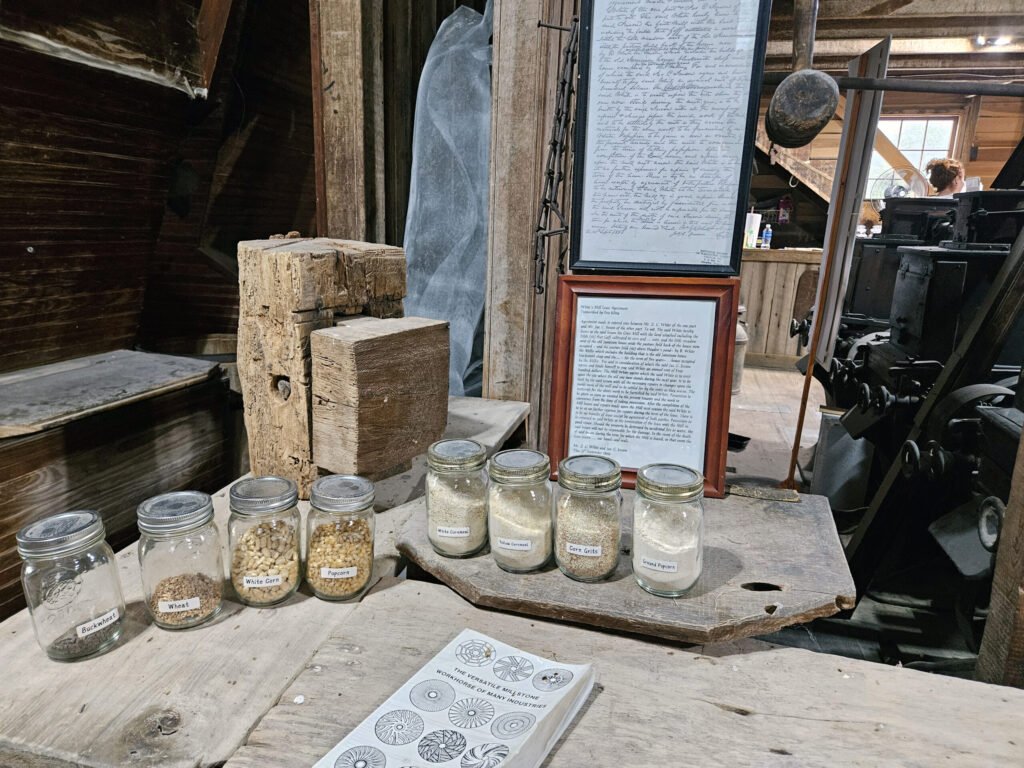
A transcript of a lease agreement displayed inside the mill adds documentary support for major work at the site immediately after the war. Dated September 21, 1866, the agreement says a mill was to be erected during the following year “upon the site where the old one now stands.” It also calls for repairs and changes to the mill’s interior, with White supplying the materials.
Historical records clearly establish the broader military context. A 1998 architectural survey prepared for the town of Abingdon and the Virginia Department of Historic Resources says Union Gen. George Stoneman led a December 1864 raid that destroyed industries and public buildings across Southwest Virginia. His troops burned Abingdon’s train depot and courthouse.
No government record reviewed for this article specifically documents an attack on White’s Mill. The evidence therefore stops short of proving the traditional account, even though the 1866 lease shows that major work followed soon after the war.
The surviving building itself contains work from more than one period. The Department of Historic Resources dates the present mill to about 1840, while the 1866 agreement describes plans for construction, repairs, and interior changes. Without a more detailed architectural study, the extent of the postwar rebuilding remains uncertain.
Preserving a system
By the end of the 20th century, White’s Mill no longer faced the problem of modernization. It faced the threat of disappearance.
The foundation’s restoration history says the White’s Mill Foundation formed in 1999 and purchased the mill, miller’s house and country store in March 2001. Workers installed new beams to repair the foundation in 2005.
The project expanded to include a new roof, siding and windows, along with major structural work on the Hurst frame and south wall.
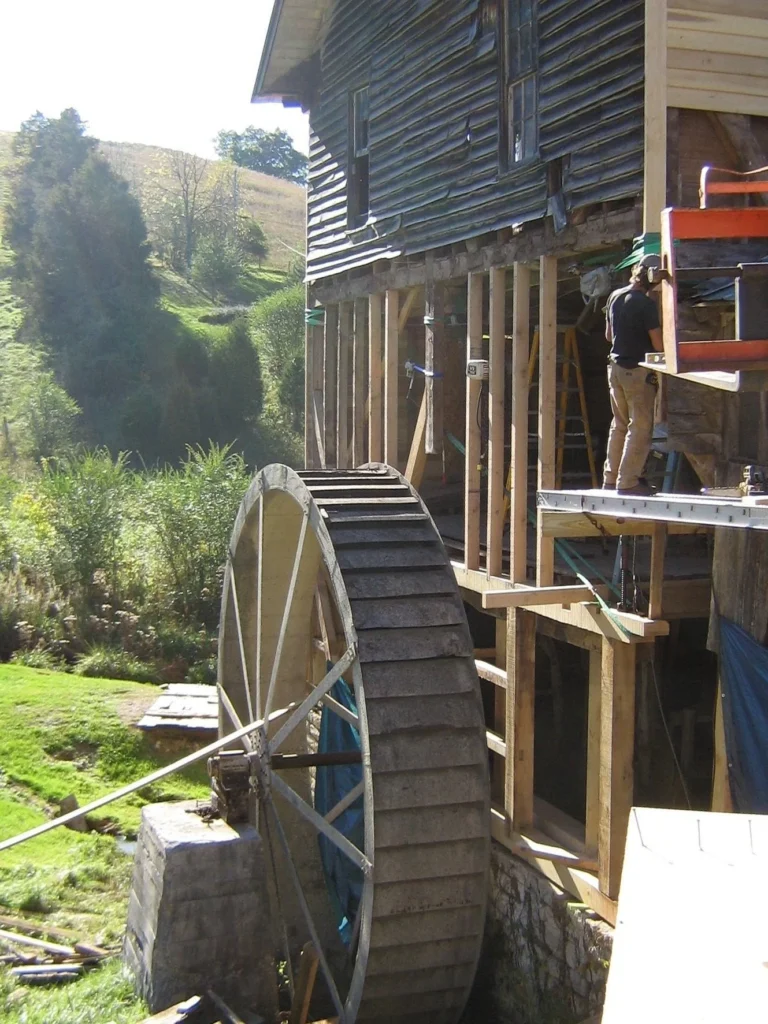
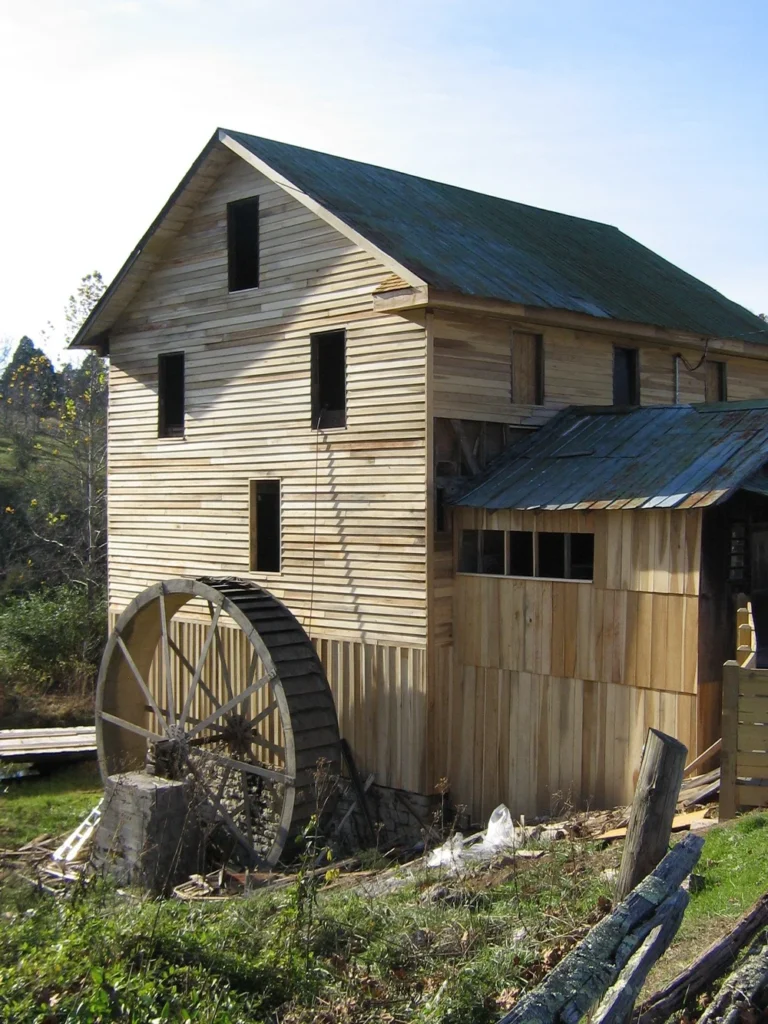
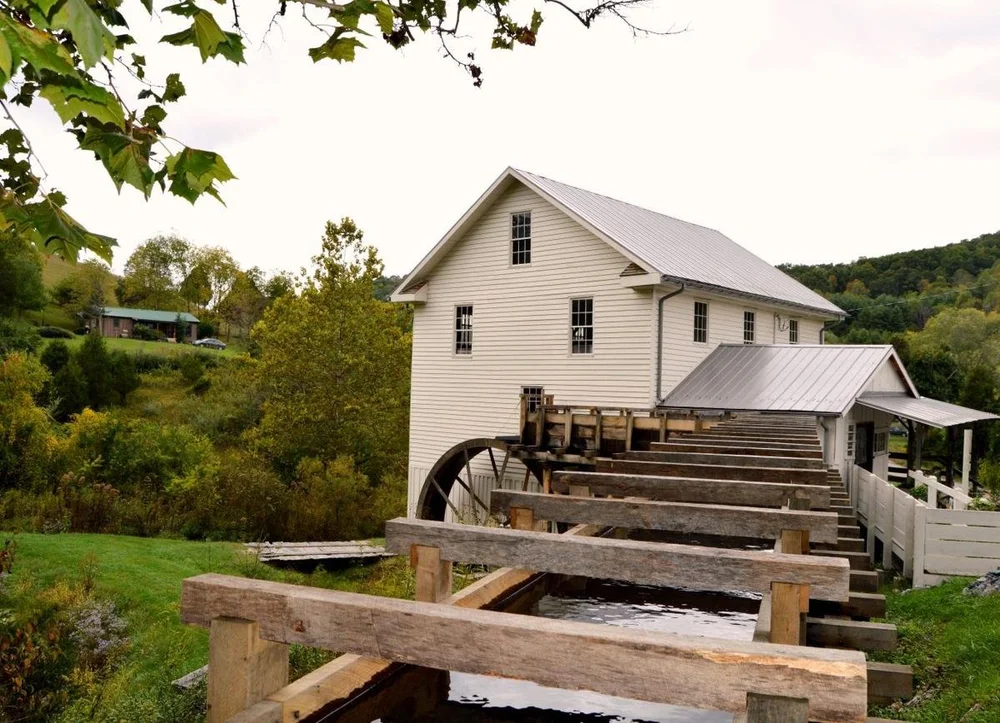
After stabilizing the building, workers cleaned the raceway that carries water from the creek and rebuilt the wooden flume that delivers it to the wheel. They also rebuilt parts of the gearing and corn stone so water could once again power the grinding system.
McConnell described the restoration as a gradual process supported by grants and donations. At the time of the interview, she said the foundation operated without bank debt and paid for projects as funding became available.
That pay-as-you-go approach helps explain why the work has taken decades. White’s Mill is not a static house museum that preservationists can stabilize, furnish and leave alone. It contains structural and mechanical systems that water, weather, motion and wear constantly challenge.
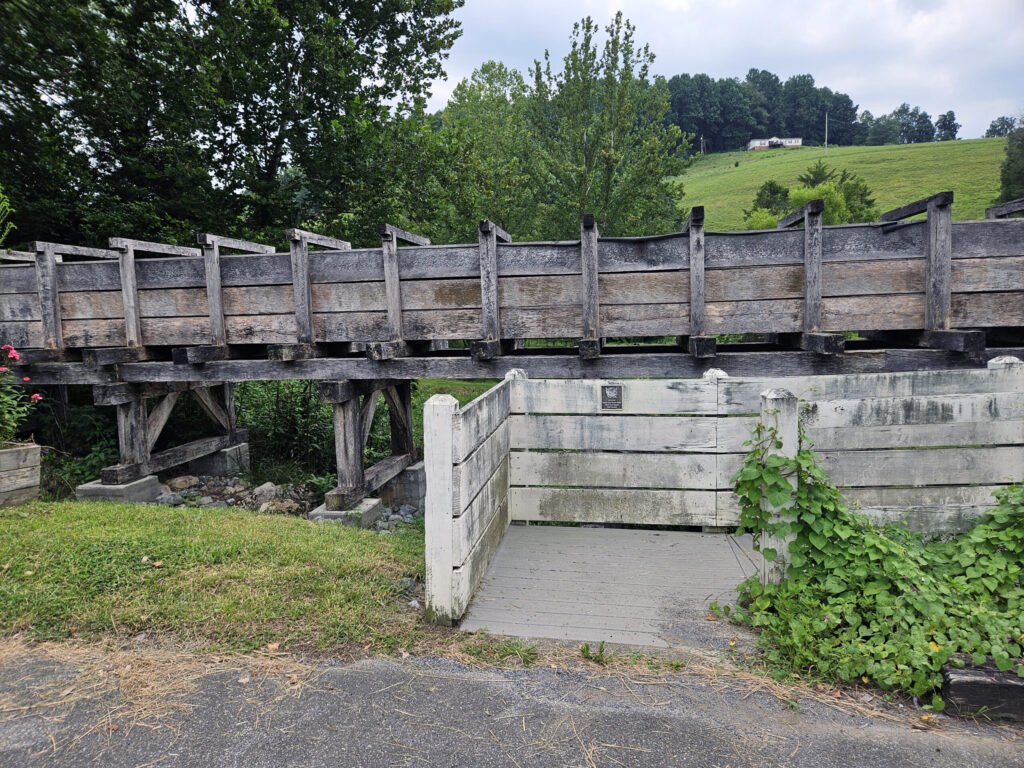
A wooden flume decays. Debris fills a raceway. Gear teeth wear or break. Timbers shift. Roofs and siding admit moisture. Shafts move out of alignment. A repair to one component can change the loads carried by another.
Operating machinery also presents a different preservation challenge than motionless machinery. Each demonstration proves that the system works, but each revolution places stress on old components.
The knowledge inside the mill
White’s Mill also depends on something less visible than its gears: people who know how to read the machinery.
Houser said he developed his knowledge by working at several mills for more than 20 years.
At one elevator housing, Houser pointed to an opening near the floor.
“That’s the bottom of it,” he said, then traced the belt’s path upward with his hand.
From there, he showed how the grain moved to its next operation. The basement, he explained, mainly housed shafts and pulleys; most of the cleaning, grinding,g and sifting took place above.
Near the stairs, Houser rapped on a tall wooden casing.
“That’s the bottom of the elevator,” he said.
I would have taken it for part of the wall. The belt and buckets ran inside it, out of sight. In the upper framing, another detail caught his eye: Roman numerals cut beside the joints so the builders could match the timbers.
A building can survive after that knowledge disappears. Machinery can remain in place, labeled and photographed. But without people who understand the relationships among the components, the mill becomes a collection of objects rather than a manufacturing system.
That may provide the strongest reason to keep White’s Mill operating and open to visitors.
More than a waterwheel
The large waterwheel draws people to the site, but the deeper story begins where the axle enters the wall. Inside stands an early automated plant, a system designed to control power, move material, sequence operations, and produce consistent goods while minimizing manual handling.
Its technology is old. Its manufacturing problems are not.
White’s Mill shows that automation did not begin with electricity, computers, or robotics. Long before factories used sensors and software, engineers and millwrights designed machines that made other machines work together.
Water supplied the energy. Gravity provided the return path. Gears controlled speed and direction. Belts distributed power. Elevators moved material. Sifters separated products by quality and grade. The building held the entire process in alignment.
Preserving White’s Mill means preserving that complete idea — not simply a wheel beside a creek, but a factory powered by water.










Leave a Reply