

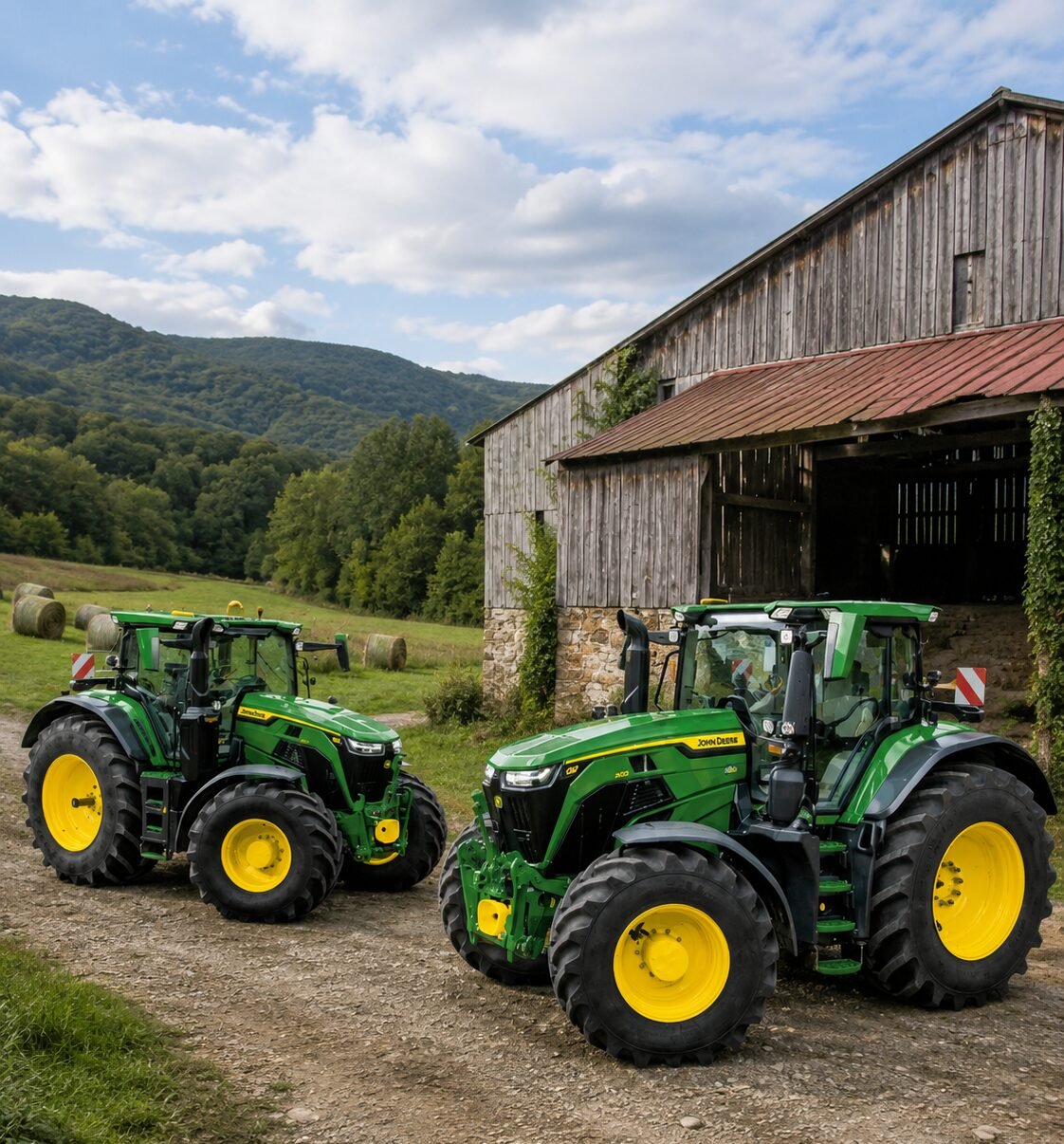
John Deere’s model-year 2027 updates to the 6R and 6M tractor lines are not just about more horsepower. For farms in the Appalachian Highlands, the more useful story may be smoother road travel, better visibility, more transmission choices, smarter loader tools, and a few questions buyers should ask before signing an order.
Deere’s June 8 update covers the 6R Large and Xtra Large Frame tractors, the 6M series, and new front loader models. The MY27 6R update includes four Large Frame models — 6R 180, 6R 200, 6R 220 and 6R 240 — plus two Xtra Large Frame models, 6R 230 and 6R 260. Launch coverage lists outputs up to roughly 300 hp with Intelligent Power Management, while Deere’s U.S. product page lists the 6R 260 at 260 rated engine hp and 286 max engine hp, with IPM available when conditions allow.
For Appalachian farmers, that matters because a tractor here often has to do more than one kind of work in a day. It may feed cattle before daylight, haul hay or manure across a two-lane road, mow a roadside, pull a baler through a tight field, and climb back to the barn before dark. Appalachia’s farm economy is diverse, with hay, livestock, row crops, horticulture, and forest-based products all playing a role, and pasture-based livestock remains especially important where mountain terrain limits row-crop ground.
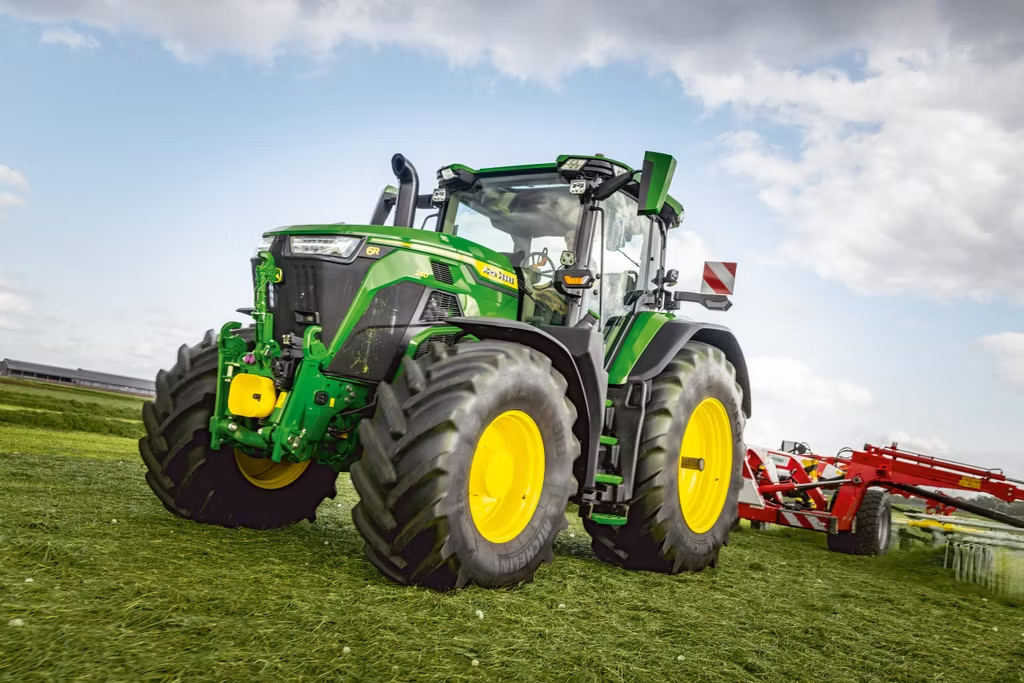
The MY27 6R: Power, Comfort and Road Manners
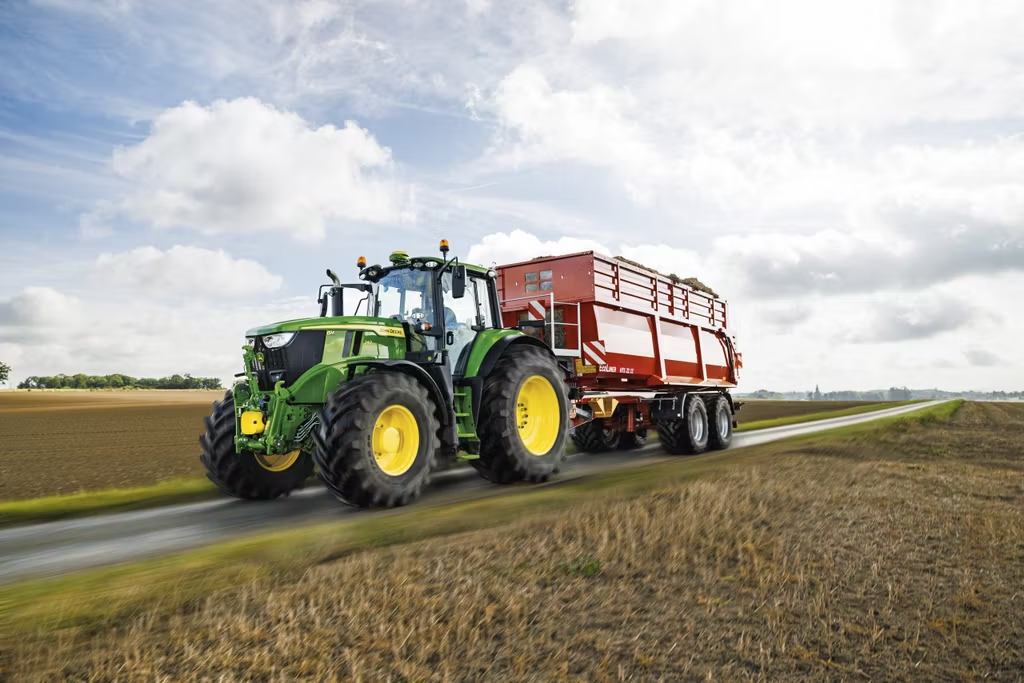
The 6R update brings Deere’s premium tractor features deeper into the mid-horsepower range. On selected 6R Large and Xtra Large Frame models, Deere lists the e19 PowerShift transmission alongside IVT. The e19 uses 19 fully powered shiftable gears, a dual-clutch range box, and proportional valves, with Deere promoting “zero torque interruption.” IVT remains the choice for operators who prefer a stepless transmission from creeper speeds up to 31 mph, depending on configuration.
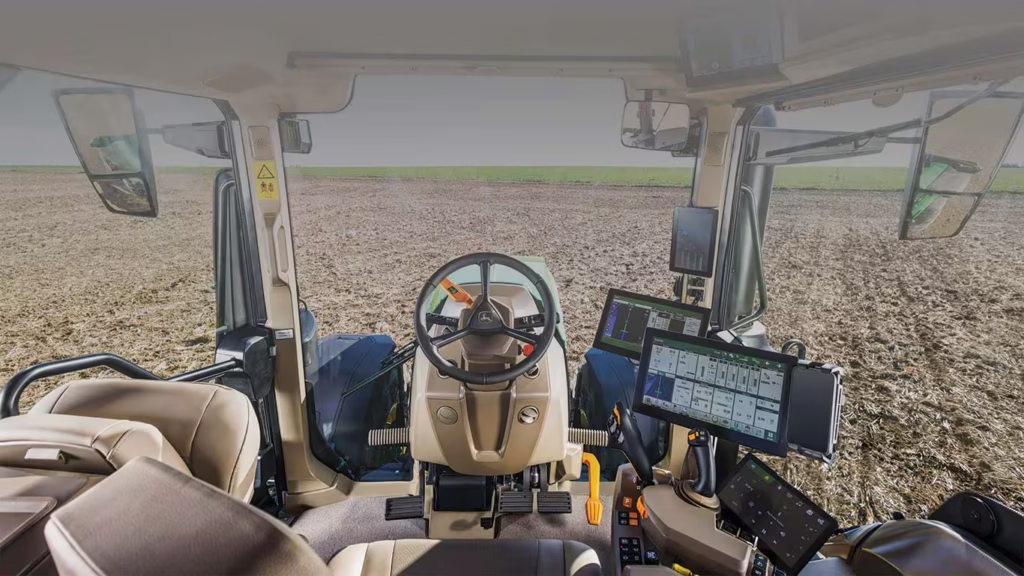
The cab update is just as important as the powertrain. Deere’s current 6R materials describe the CommandView 4 premium cab as quieter and more spacious, with four seat choices, improved air conditioning, and an upgraded sound system. Deere also says rear visibility is improved by 20%, aided by a larger rear window and a corner-post display that keeps common readouts in the operator’s line of sight.
That rear visibility may not sound like a headline feature until you spend a day hitching hay tools, backing wagons into short barn lots, or watching a mower on a bank. In hill country, being able to see the implement, the bank, the ditch, and the next gate is not a luxury. It is part of getting home without bending iron.
The 6R also gets attention in the suspension and transport department. Deere’s Sport Package Pro combines chassis, steering, and braking updates intended to improve stability, ride quality, and steering precision on-road and off-road. The package centers on the TLS Pro front-axle suspension, which uses adaptive, adjustable damping and responds to speed, load, and surface conditions. Deere also pairs TLS front suspension with hydraulic cab suspension for a smoother ride.
That is relevant in the Highlands, where farms are often split among several parcels and transport time is part of the job. A 31-mph transport speed will not fix narrow roads or blind curves, but better steering, braking, suspension, and visibility can make road moves less tiring and more controlled.
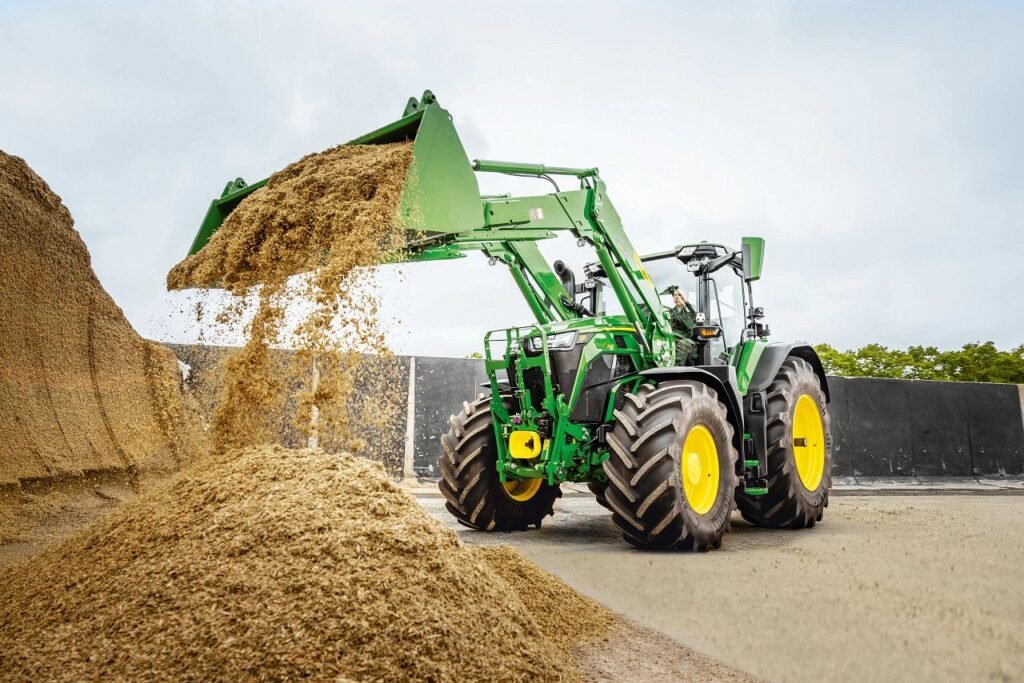
Loader Work Gets Smarter
For beef, dairy, and mixed livestock farms, the loader may matter as much as the drawbar. Deere’s updated 6R loader technology includes Dynamic Weighing, Level to Horizon, Return to Position, and an optional loader camera. Dynamic Weighing is designed to weigh bales or feed material on the move; Level to Horizon helps the loader compensate for changing terrain; Return to Position brings the boom and bucket back to preset positions; and the camera gives the operator a better view of the loader carrier and working area through the tractor display.
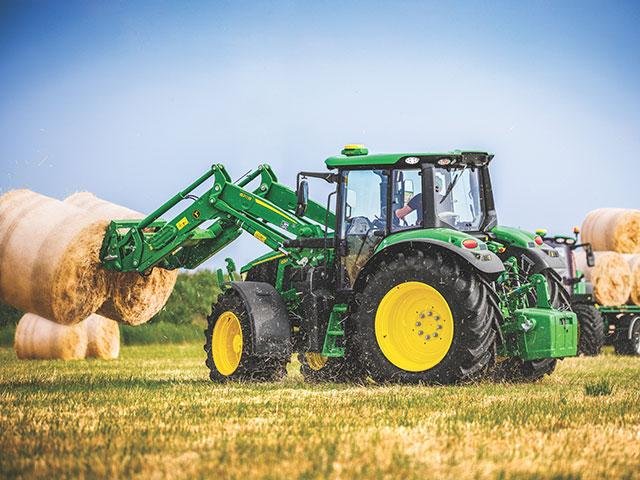
Those features fit everyday Appalachian chores: moving baleage, loading feed, cleaning lots, stacking hay, bedding barns, and carrying material across sloped yards. The main promise is not that technology replaces judgment. It is that the operator may make fewer extra trips, spill less material, and spend less time guessing how much feed or bedding is in the bucket.
Deere has also added two new loaders, the 665R and 685R, developed for the latest Large and Xtra Large Frame 6R tractors. These loaders add a multi-position digital camera that can mount on the boom or torque tube, visible latch-point cutouts to help confirm attachment from the cab, and a two-position bucket level indicator for switching between buckets, bale spikes, and pallet forks.
That last point is worth noting. Many farms here use the same tractor for a bale spear in the morning, a bucket at noon, and forks by evening. Anything that makes attachment changes clearer and more repeatable is likely to matter in real work, especially when several operators use the same tractor.
Why the 6R May Fit Some Appalachian Operations
The updated 6R is probably more tractor than many small hill farms need, but it could fit larger beef, dairy, hay, and mixed operations that spend heavy hours in transport, loader work, and baling.
On steep ground, traction and stability start with tires, ballast, wheel spacing, and operator judgment. University of Kentucky Extension describes steep terrain for livestock forage production as 20% to 30% slope, with severe limits for row-crop use and a stronger fit for pasture and hay production. Virginia Cooperative Extension likewise notes that steep pastures require careful management to provide year-round grazing.
That means the tractor’s technology should be viewed as one part of the setup, not the whole answer. A buyer looking at a MY27 6R for steep farms should talk with the dealer about ballast, tire package, rim and axle configuration, braking, loader capacity, transport loads, and whether the tractor will spend more time pulling, loading, or hauling.
The Updated 6M: More Technology Without Full 6R Luxury
The 6M update may be the more practical story for many Appalachian farms. The 6M line remains Deere’s more utility-minded 6 Series option, but the MY27 updates bring more consistency in cab layout, controls, and precision-ag functions across the tractor range. Marcus Luchmann, Deere’s go-to-market manager for Europe and CIS tractors, described the 6M update as “all about consistency, usability and versatility,” with Deere aiming to make 6M tractors easier to integrate into fleets that also run larger machines.
The key correction here is that the e19 transmission should not be described as universal across every 6M. Deere’s current U.S. 6M page lists e19 availability for selected models and configurations, including 6M 145, 155, 165, 180, 200, 220, 230, and 250, while other models continue to use combinations of PowrQuad, AutoQuad, CommandQuad, and IVT, depending on horsepower and configuration.
That gives farmers more room to match the tractor to the job. A smaller 6M may still be the better fit for loader work around barns, mowing, feeding, and tight gates. A larger 6M with e19 or IVT may make more sense for baling, road transport, manure handling, and larger hay tools. The point is not simply “6M gets 6R technology.” The point is that the 6M lineup now offers more options for choosing how much technology, transmission refinement, and operator comfort the farm actually needs.
For many cattle and hay farms in the Highlands, that may be the real buying question: do you need the premium comfort and loader integration of a 6R, or would a well-equipped 6M handle 90% of the work at a more practical price?
Connectivity: Useful, But Ask About Dead Zones
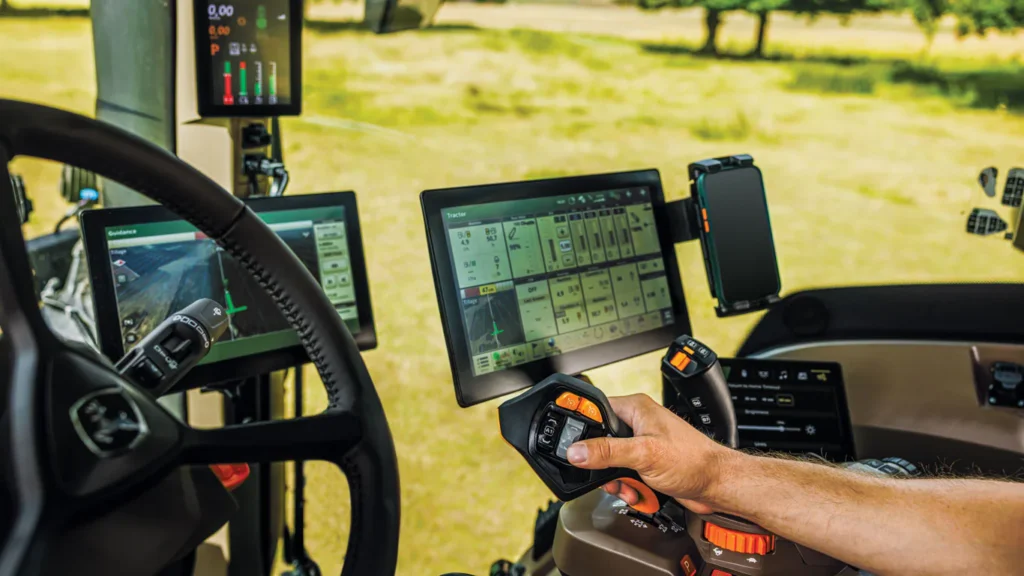
Deere continues to push connected machines through JDLink and Operations Center. On the 6R, Deere says JDLink can stream machine and field data to the Operations Center and enable machine-to-machine communication and remote dealer access. Deere’s product footnotes also state that JDLink requires a cellular connection and that buyers should consult a dealer for coverage availability.
That matters in the mountains. A tractor may have a strong signal near the dealership and a poor signal in a hollow, behind a ridge, or on a remote hayfield. Deere offers JDLink Boost as a satellite connectivity option in areas where cellular or internet service is limited or unavailable, but buyers should ask whether it is available, compatible, and worth the cost for their operation.
The practical question is simple: will the connected features work where the tractor actually works?
Data, Diagnostics, and Repair Questions
As tractors become more software-driven, buyers should also ask what data is collected and who can see it. Deere’s Data Services page says JDLink services may collect machine health, efficiency, and function data, including diagnostic codes, machine settings, software and firmware versions, attachments, implements, hours, lifetime usage, and machine location.
That information can be useful for maintenance, fleet management, and dealer support. It can also raise questions about permissions, privacy, repair access, and who controls the data. Farmers should ask the dealer how data-sharing permissions are set, how remote support works, and what happens when a machine needs a software-related repair during hay season or a tight feeding window.
There is also a broader right-to-repair backdrop. In January 2025, the Federal Trade Commission and several states sued Deere, alleging that repair restrictions drove up farmers’ repair costs and limited timely repairs. Deere has also reached a proposed $99 million settlement in separate class-action right-to-repair litigation, with preliminary approval reported in May 2026; that settlement included no admission of wrongdoing.
That does not mean farmers should avoid the new 6R or 6M. It does mean buyers should ask direct questions before purchasing: what diagnostic tools are available to the owner, what repairs require dealer software, how quickly the dealer can respond during peak season, and what options exist if the tractor is down in a remote area.
Which Farms Should Look Closely?
The updated 6R deserves a close look from larger beef, dairy and hay operations that do heavy loader work, pull larger balers or forage equipment, spend a lot of time on the road, or need premium comfort for long days. The loader camera, Dynamic Weighing, Level to Horizon, and Return to Position features are especially relevant for farms that feed daily and handle large volumes of material.
The updated 6M may be the better fit for farmers who want newer controls, connected features, and selected e19 availability without moving all the way into the premium 6R price and comfort tier. A 6M in the middle of the range could be a strong match for loader work, mowing, baling, manure hauling, and general livestock chores.
The largest 6R and 6M models may be more machine than many small farms need. Before jumping to horsepower, farmers should look at the work: implement size, loader hours, road miles, barn access, field slope, service distance, and whether the tractor will be run mostly by one experienced operator or by several people.
Buyer Checklist for Appalachian Farms
Before ordering a MY27 6R or 6M, ask the dealer these questions:
Which exact models offer e19, IVT, G5 CommandCenter, and CommandX in this market? Availability varies by model and configuration.
Which loader fits the tractor frame? Ask specifically about compatibility with 665R, 685R, and the existing 600R-series loader.
How accurate is Dynamic Weighing with your attachments? A bucket, bale spear, and pallet forks may behave differently, especially on uneven ground.
What ballast and tire setup does the dealer recommend for slopes? Do not treat horsepower as a substitute for proper weighting, wheel spacing, and traction.
How will the tractor handle road transport? Ask about braking, steering, suspension, trailer loads, visibility, and whether Sport Package Pro is worth adding.
Will JDLink work on your farm? Check cellular coverage in the fields, hollows, and barn lots where the tractor will actually be used.
Who can see the machine data? Ask how Operations Center permissions are managed.
What repairs require dealer software? Ask what the owner can diagnose, what the dealer must handle, and what response time looks like during hay season.
What is the real delivered price? Public specs are only the beginning. Transmission, loader, display, tire, ballast, lighting, hydraulic, and connectivity choices can change the final cost quickly.
The Bottom Line
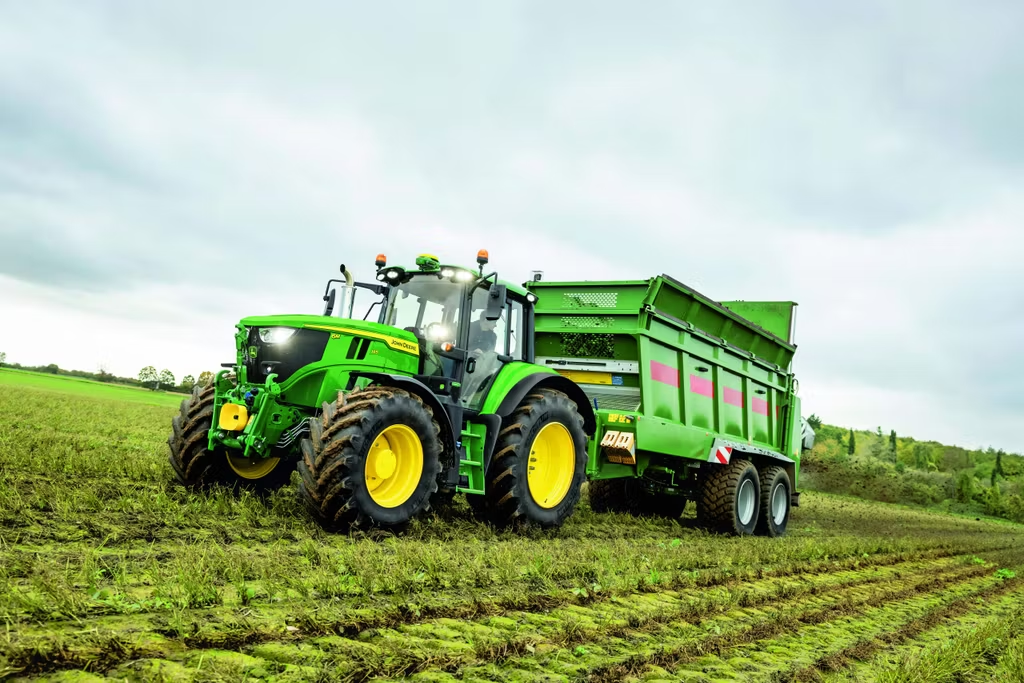
John Deere’s MY27 6R and 6M updates bring useful technology into tractors that fit many livestock, hay, and mixed-farm jobs. For the Appalachian Highlands, the strongest selling points are not just horsepower. They are smoother road manners, better visibility, smarter loader work, more transmission choices, and improved operator comfort.
The 6R is the premium choice for farms that need high-hour comfort, heavy loader integration, and stronger transport capability. The 6M is the practical alternative for farmers who want newer controls and selected premium features without necessarily stepping into the full 6R package.
Either way, the smartest purchase will depend less on the brochure and more on the farm: the slopes, roads, barns, fields, attachments, dealer support, and cell coverage. Deere’s updates are worth a look, but the right questions still need to be asked from the seat, the shop, and the hillside.












Leave a Reply