

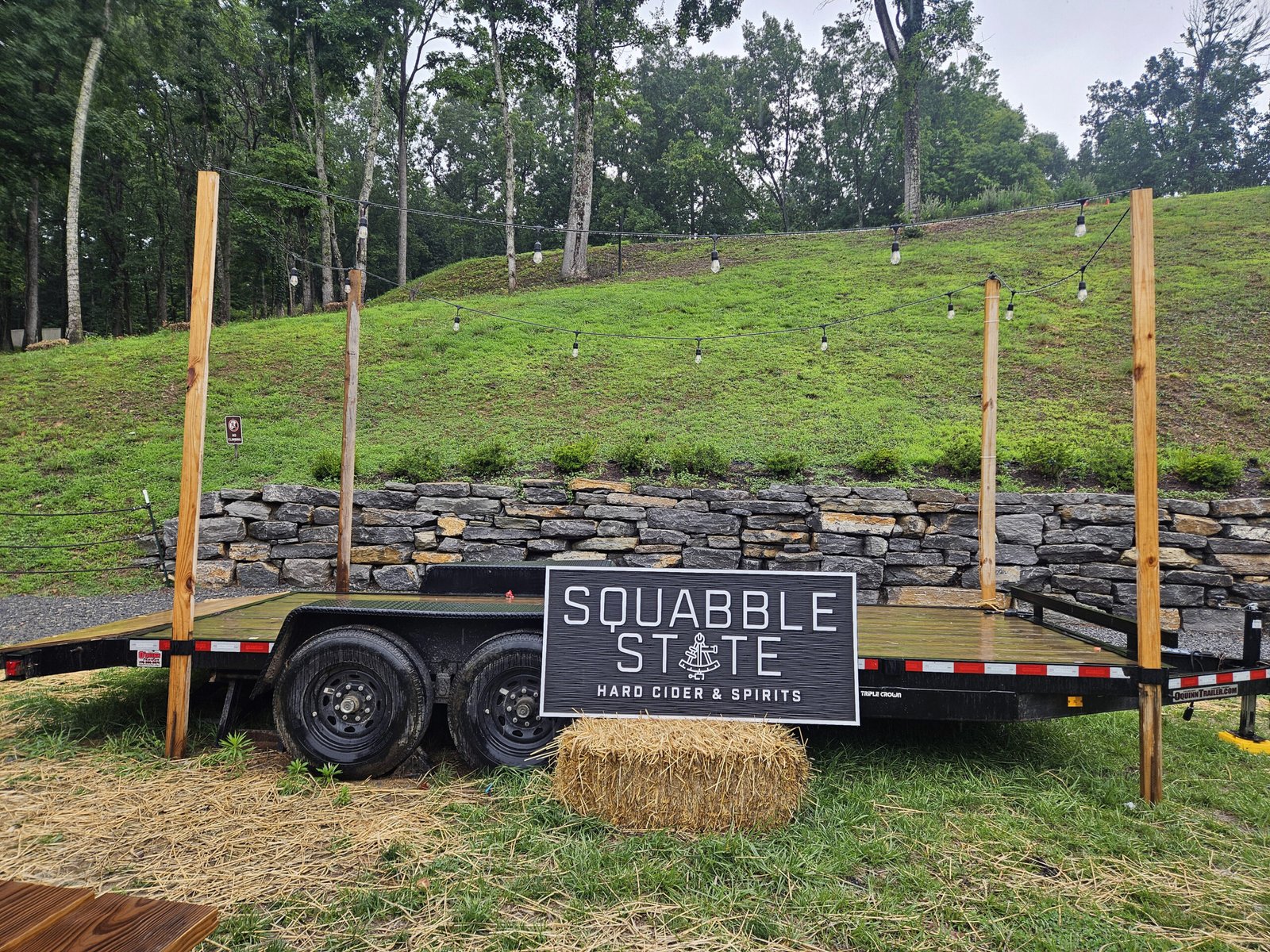
Rain followed vendors to the July 12 Squabble State pop-up market, but so did shoppers, drawn by hot food, flowers, honey, herbs, preserves, and hand-built pottery.
The first thing to reach us at Squabble State Hard Cider & Spirits was not the view. It was the smell coming from the first tent.
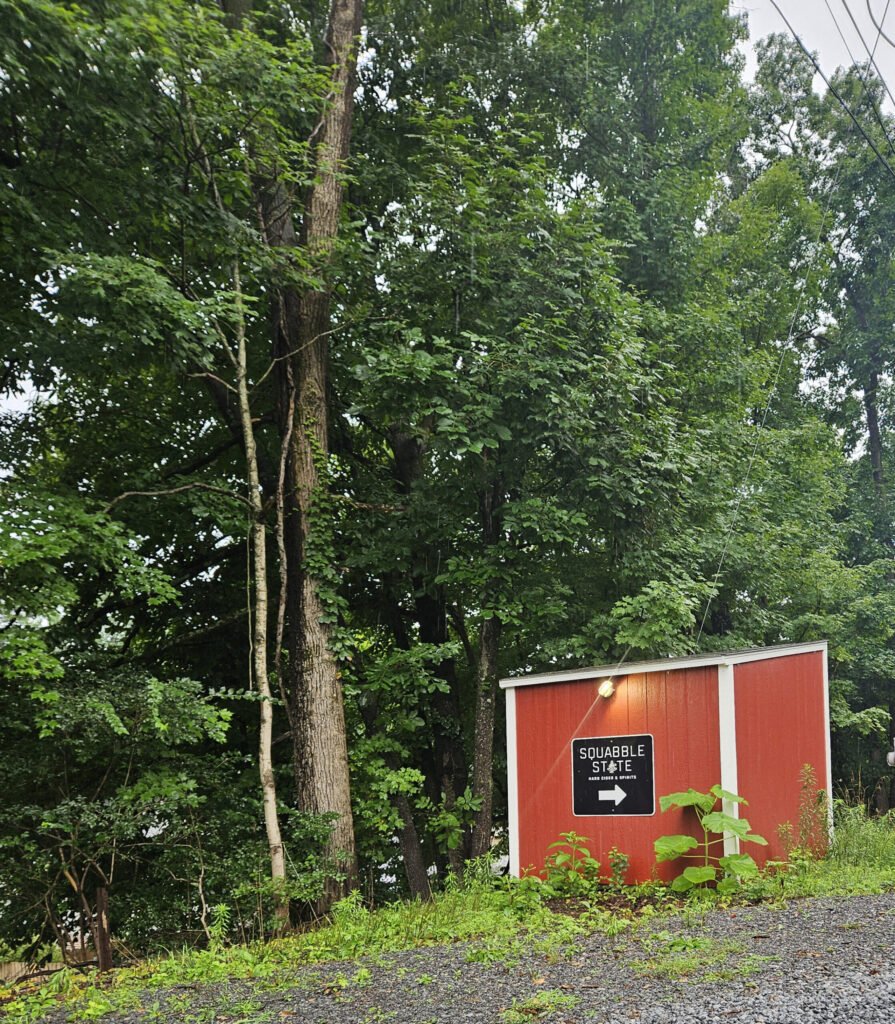
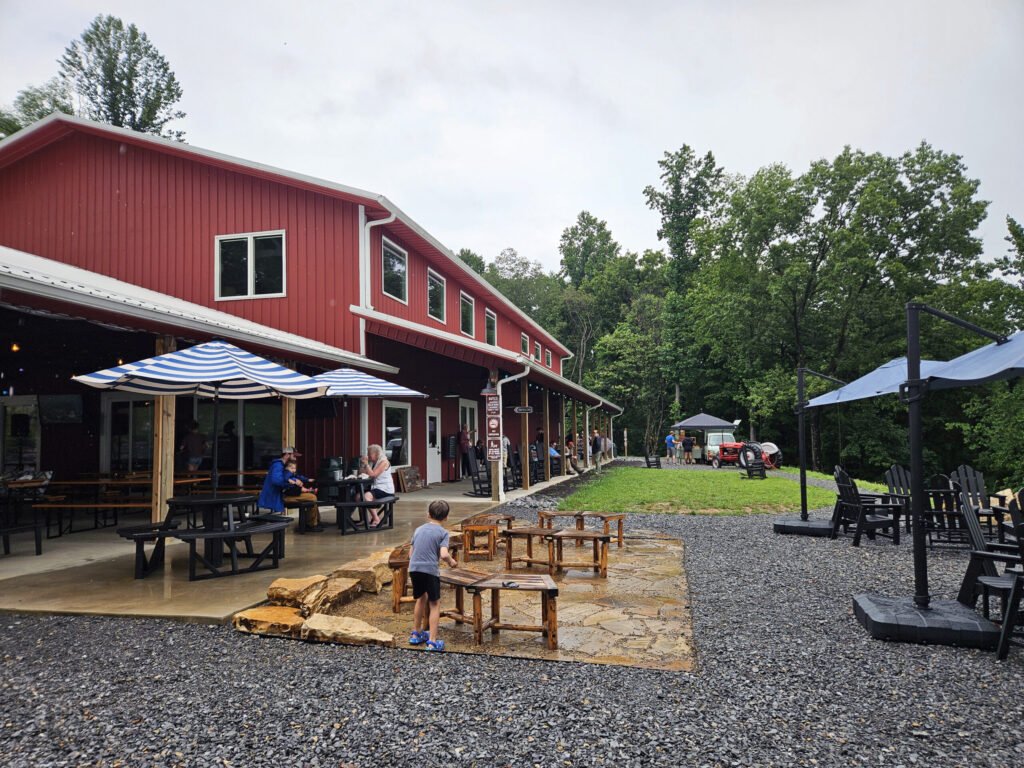
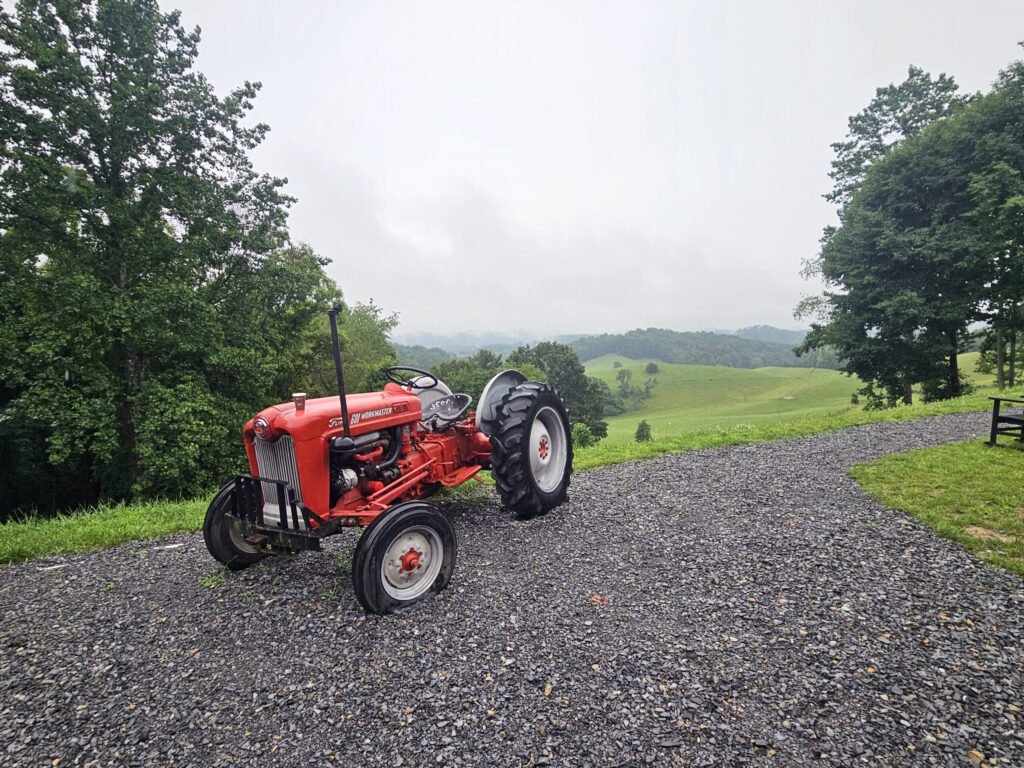
Rain had settled over the property outside Bristol, softening the green mountains and partially hiding the ridgelines beyond the cidery. Cattle grazed in the distant valley. Vendor tents stood along the wet gravel beside Squabble State’s red metal building, while the covered pavilion offered shelter beneath its black rafters and string lights.
But before any of that could hold our attention, the aroma of bacon, cheese, and potatoes pulled us toward the grill.
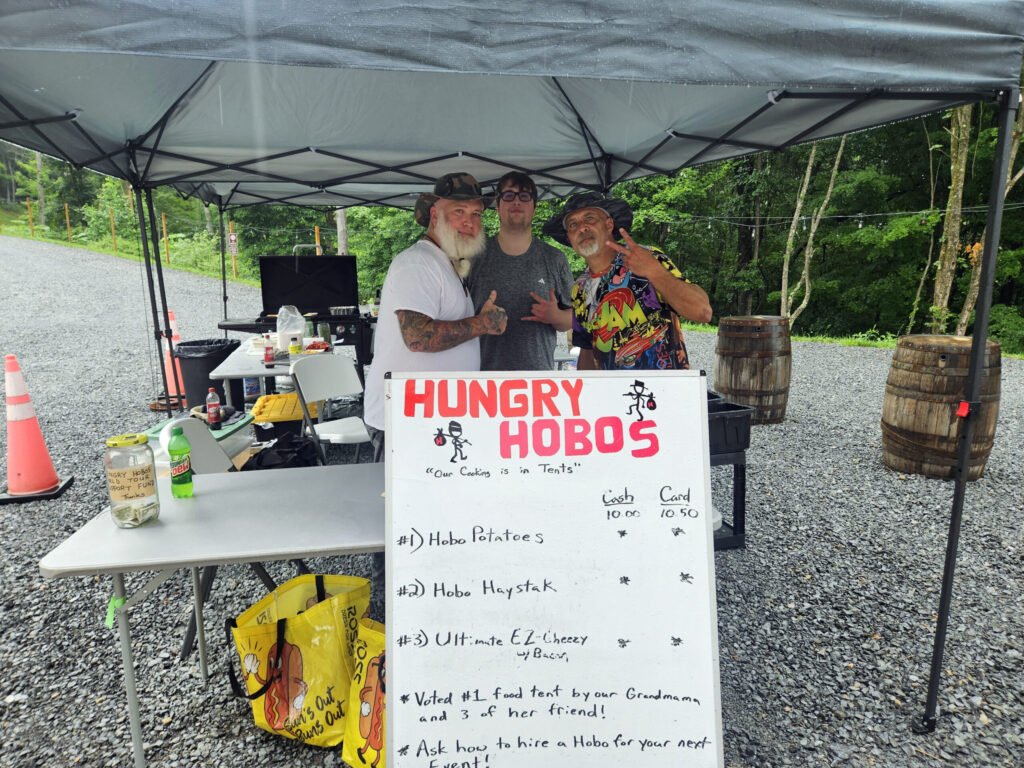
Hungry Hobos at the First Tent
Darby, Ethan, and Rob call themselves the Hungry Hobos, an Abingdon-based food crew that travels to fairs, private events, and other gatherings around the region.
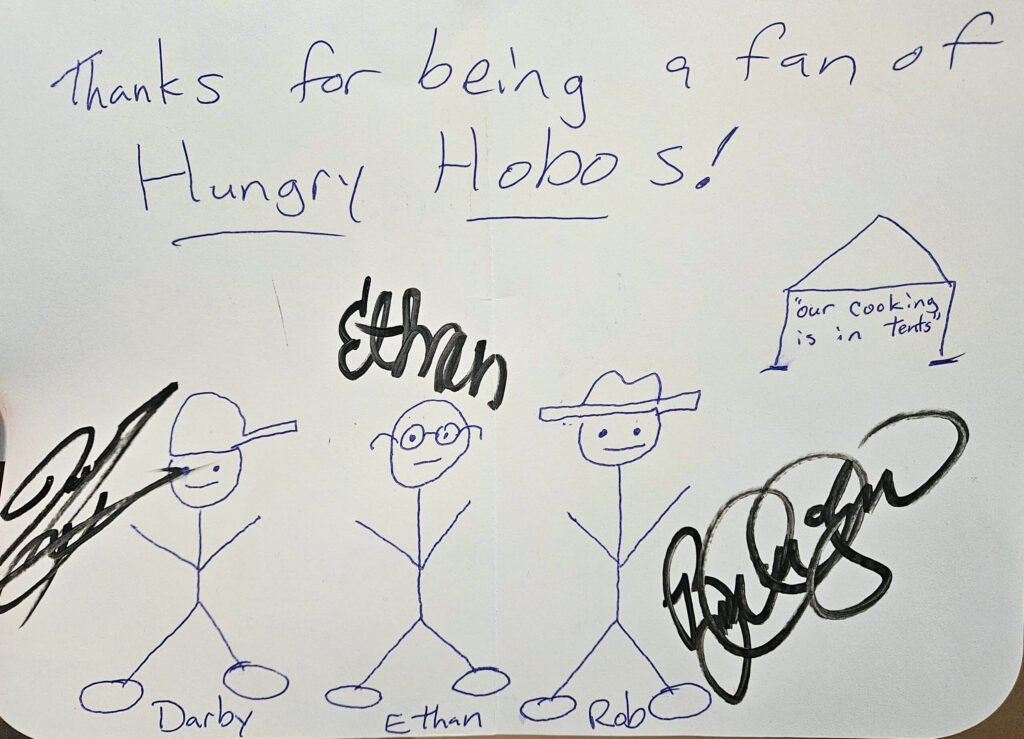
Their setup reflects the same sense of humor as their name. Customers receive large, oblong cards folded in half and printed with stick-figure drawings of the three men. Each has signed beside his illustrated likeness. The cards thank customers for being fans of Hungry Hobos and carry the crew’s slogan: “Our cooking is in tents.”
Darby and Ethan handled the cooking while Rob worked the front of the tent, talked with customers, and occasionally handled the less-entertaining parts of operating a food stand.
At one point, he had to redirect a visitor who had stepped beneath the canopy.
“You can be in this tent, but not that tent,” he explained, warning that the arrangement could otherwise result in a health department fine because the other tent was where the cooking was happening.
Rob also handed out KOPIKO cappuccino candies, which he said he was promoting for a friend.
When asked whether Hungry Hobos had a social media presence, he seemed less certain.
“Do we have FaceTick, Instabook, or something?” he asked. “Somebody else does that for us.”
The crew’s food was easier to identify.
Rob introduced what he called their “world-famous Hobo Potatoes” and said the group had served more than five tons of them since the previous August.
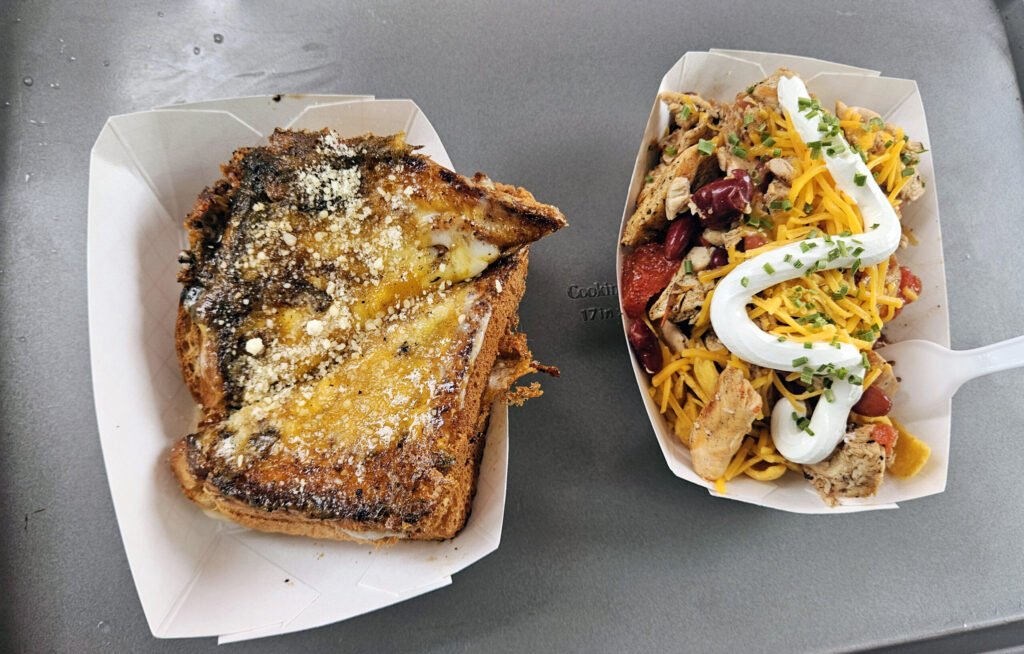
They were also making the Hobo Haystack, chicken chili served over corn chips, and the Ultimate EZ-Cheezy, a grilled cheese sandwich with bacon and three kinds of cheese.
The portions were large, the grill stayed busy, and the rain did little to diminish the line of people drawn toward the tent.
The Fleenors Fire Up the Grill
The next grill belonged to familiar faces.
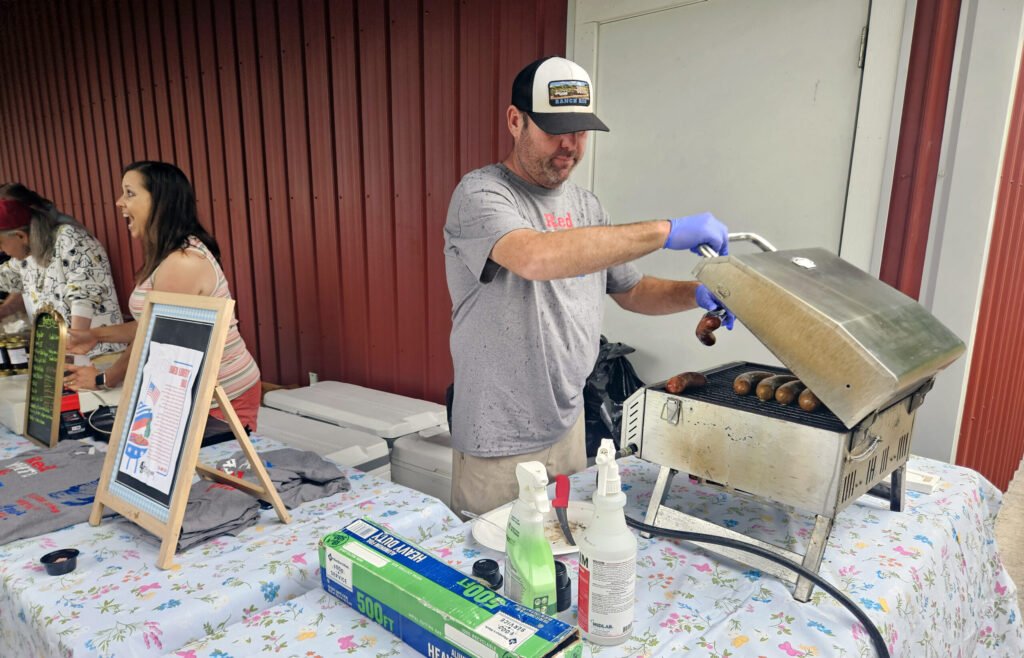
Keith and Sabrina Fleenor operate Fleenor Farm and the Washington County Meat Packing Company in Bristol, Virginia. They were joined at the market by their son, Jackson; his wife, Keelie; and their daughter, LeDoux.
Keith sat on the left side of the booth, holding his granddaughter, while Sabrina, seated to his right, leaned over to talk to the baby. The three generations gathered beneath the canopy offered a glimpse of how closely the family and the business are connected.
Jackson raises cattle and competes in rodeos. Keith and Sabrina tend the farm and operate the meat-processing facility, where the family has developed a growing rotation of bratwurst flavors.
Their lineup has included Bell Pepper and Onion, Country Pinwheel, Cowboy Butter with Pepper Jack Cheese, Hatch Green Chili, Tomato Basil, Jalapeño, Chorizo, and Woodfire Pizza with Mozzarella.
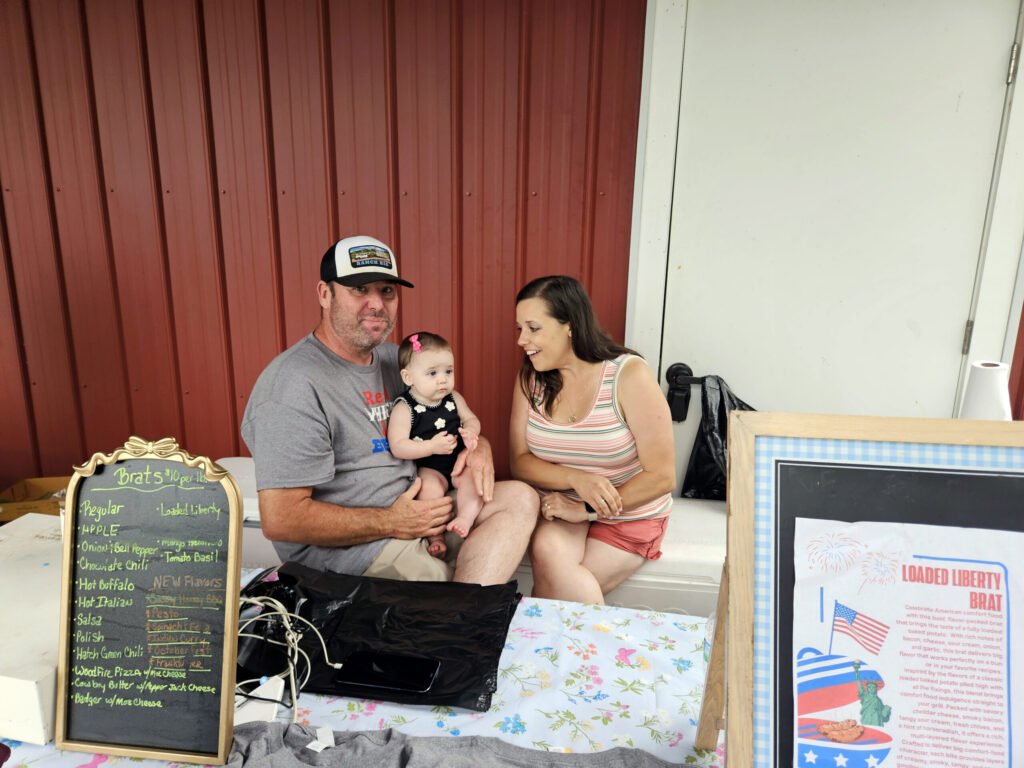
On this particular Sunday, they were serving Woodfire Pizza and a brat called Loaded Liberty.
“This is Loaded Liberty,” Keith said as the brats came off the grill.
What was in it?
“Bacon ranch,” he answered.
The family’s recipes are not developed by one person working alone.
“Our kids try to really help us with ideas,” Sabrina said. “We just kind of look through different seasoning profiles and try to come up with — pick out stuff that we think folks will like.”
At the market, those ideas were tested in the most direct way possible: hot from the grill and handed to customers as samples.
CFLM Farms Brings Eggs and a Family Mission
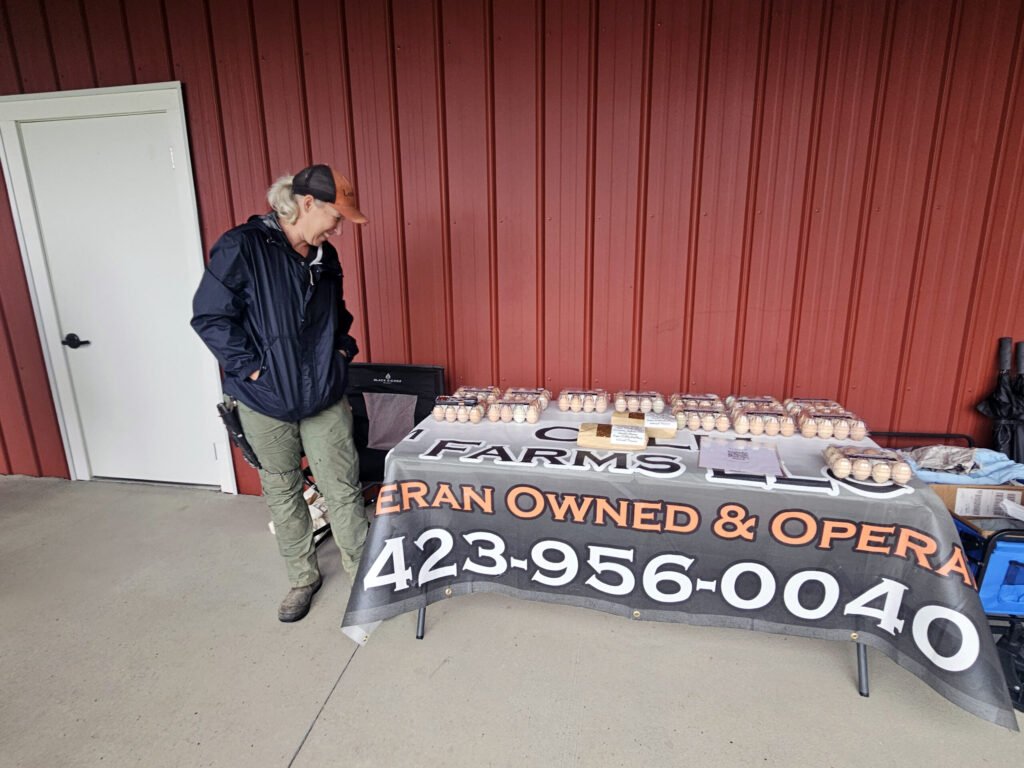
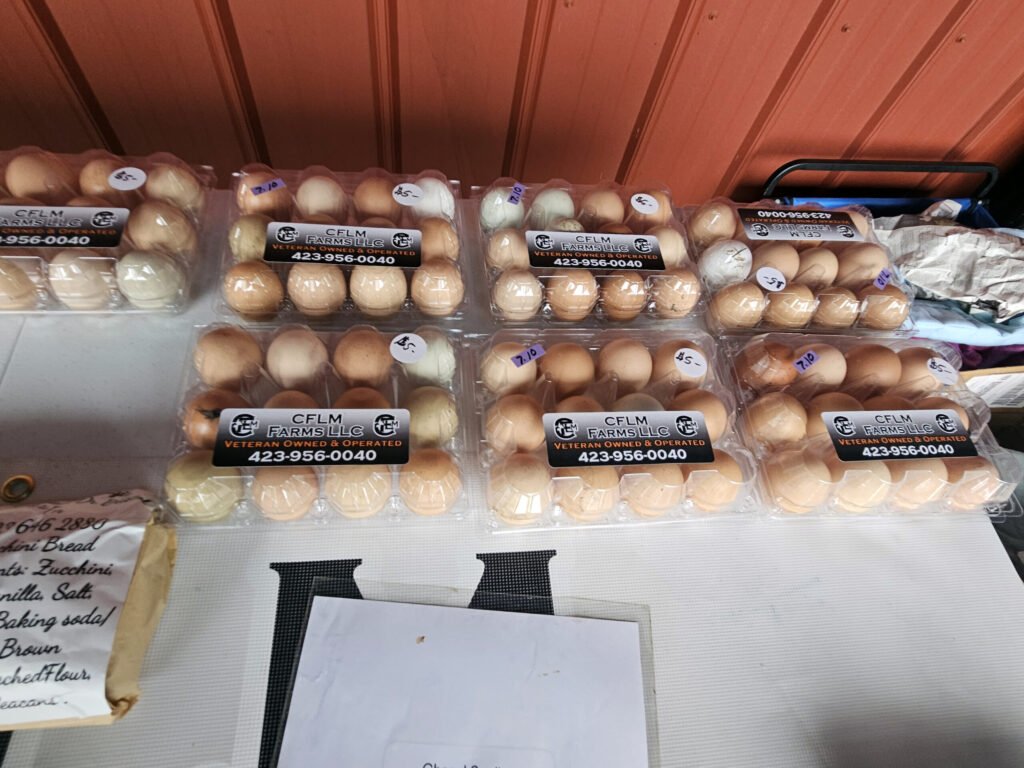
A few tables beyond the grills, Cheryl Foran represented CFLM Farms LLC with cartons of fresh eggs priced at $5 a dozen.
Cheryl and her husband, Chad Foran, operate CFLM as part of a larger family farming arrangement. The business name comes from the initials of close family members, reflecting the way several relatives cooperate while maintaining their own farms and parcels of land.
The family uses four separate tracts to manage its cattle. Cows ready for breeding are moved to the property where the bull is kept. After calving and weaning, the younger animals are separated and moved again, preventing them from breeding too early or with closely related cattle.
The arrangement also provides enough pasture and storage space for the family to feed what Cheryl described as field-grown, horse-quality hay throughout the year.
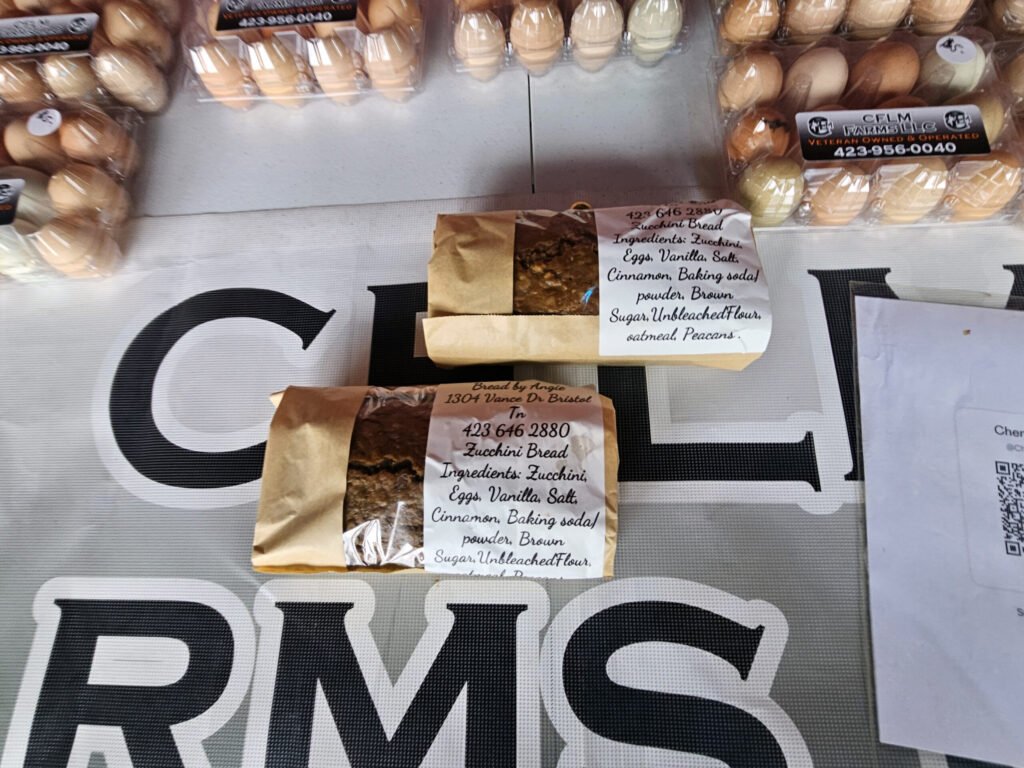
CFLM produces beef and raises chickens, geese, ducks, and turkeys. The family is also preparing to add rabbits and quail. Cheryl said their cattle are processed at a federally inspected facility, allowing them to sell the beef to the public. The family expects to work with the Fleenors at the Washington County Meat Packing Company for that processing.
At the Squabble State market, however, the eggs were the immediate offering. Cheryl said exemptions for smaller producers allow the farm to sell eggs directly at farmers markets without incurring the expense of supplying grocery stores or restaurants.
Chad grew up around livestock in the Abingdon, Bristol, and Glade Spring area and describes himself as “an Appalachian woodsman.”
Cheryl came to farming by a different route. She grew up in Southern California and moved to East Tennessee about six years ago. Farming had been a childhood dream, even when her surroundings made it difficult.
At one point, she said, she had accumulated approximately 14 animals in her bedroom and around her father’s house.
“My dad will tell you he spent most of my childhood preventing me from turning my bedroom and the backyard into a farm,” she said.
His rule was that her allowance had to pay for the animals’ feed and that the house and yard could not smell like animals.
After moving to Tennessee, Cheryl met Chad’s twin brother through their work as contractors. He introduced her to cattle, and she later met Chad. Together, they began building the mixed-animal farm she had imagined as a child.
The family initially wanted greater control over where its own food came from. That goal expanded into producing affordable food for other people in the community.
CFLM donates food to churches and organizations, including the Haven of Rest. Cheryl said the family also gives directly to people who need help.
“Our policy is nobody goes hungry,” she said. “If you can’t afford eggs, you’re going home with eggs.”
The market cartons may have been marked $5 a dozen, but Cheryl made it clear that feeding someone mattered more than completing a sale.
“Absolutely nobody goes hungry,” she said. “If I can prevent you from going hungry, I absolutely will.”
Alethia Fields: Flowers and Family Stories
Beyond the food tents, the market shifted from the smell of hot grills to tables filled with flowers.
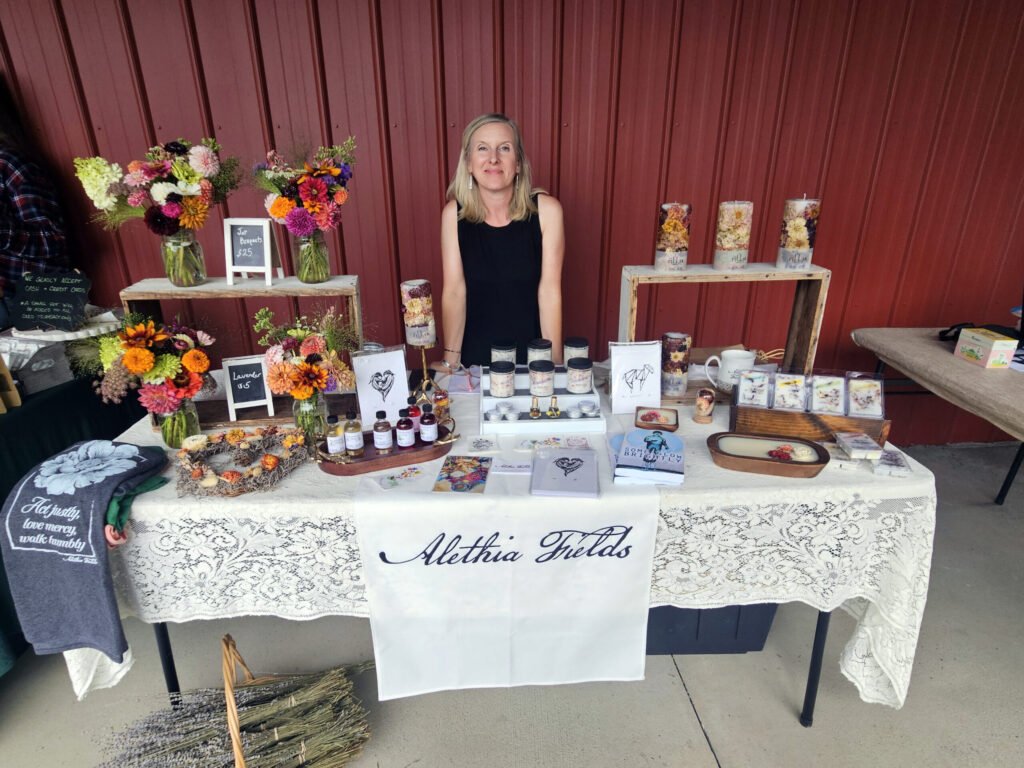
Tina Gregg represented Alethia Fields, a small family flower farm in Bluff City specializing in seasonal and heirloom cut flowers.
The name of the farm comes from the Greek word for truth, but its significance to the Gregg family is more personal.
“We used to tell our son stories from the Forest of Alethia when he was a little boy,” Gregg said. “And it just kind of turned into our name.”
That family storytelling tradition extended beyond the farm’s name.
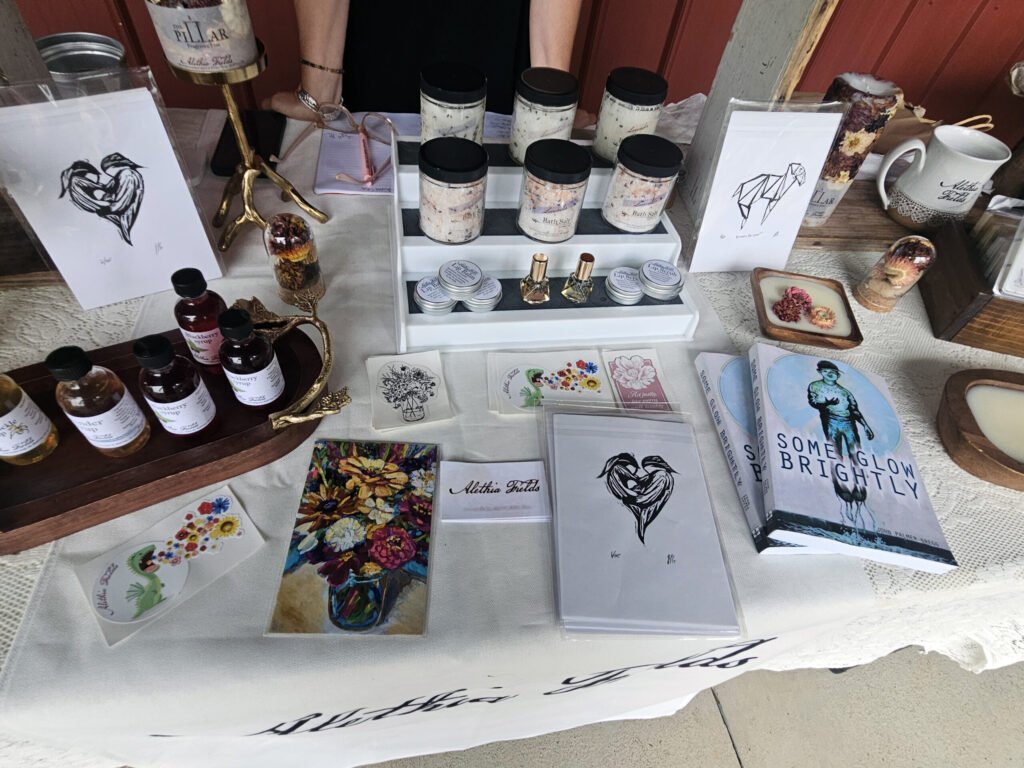
Copies of Some Glow Brightly, a young adult fantasy novel written by Gregg’s husband, John Palmer Gregg, were displayed among the flowers. He previously worked in newspapers as a writer and photographer before turning his attention more to farming.
The book has attracted readers who are waiting for a sequel, but farming has complicated the writing schedule.
“Lots of people are waiting for the sequel,” Tina Gregg said, “but he’s a farmer and doesn’t have time to write the sequel.”
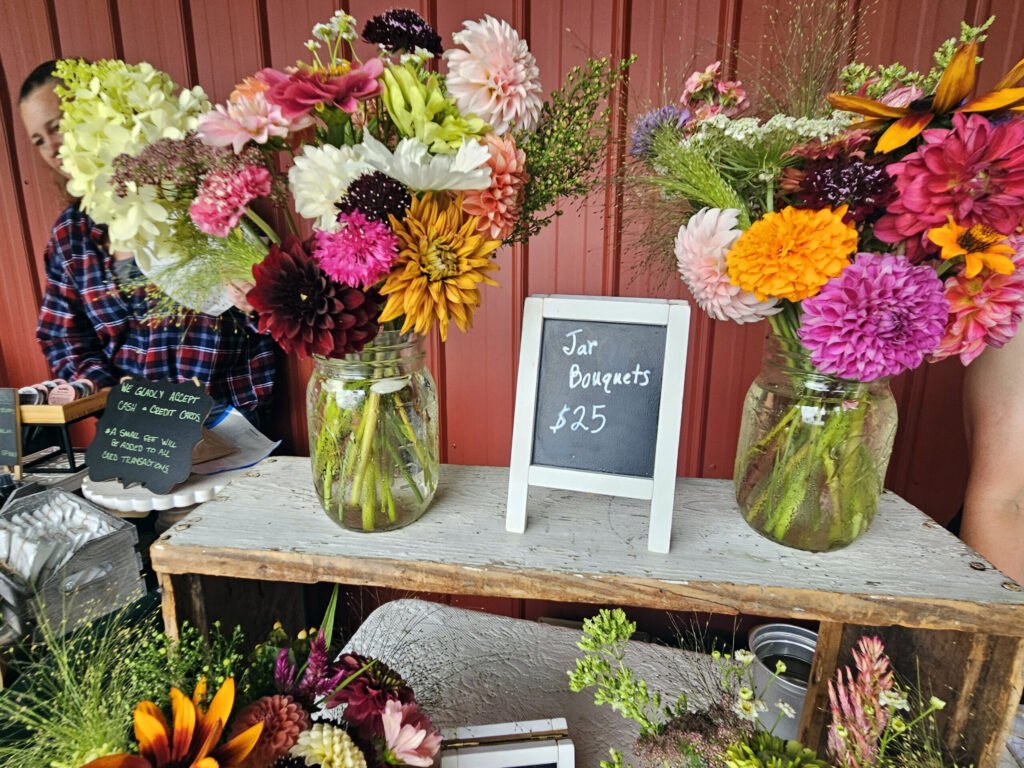
At Alethia Fields, flowers and storytelling have grown alongside one another. One began with a collection of family bedtime stories. The other now occupies the family’s fields.
Honey Blossoms Farm and a Truck Named Olive
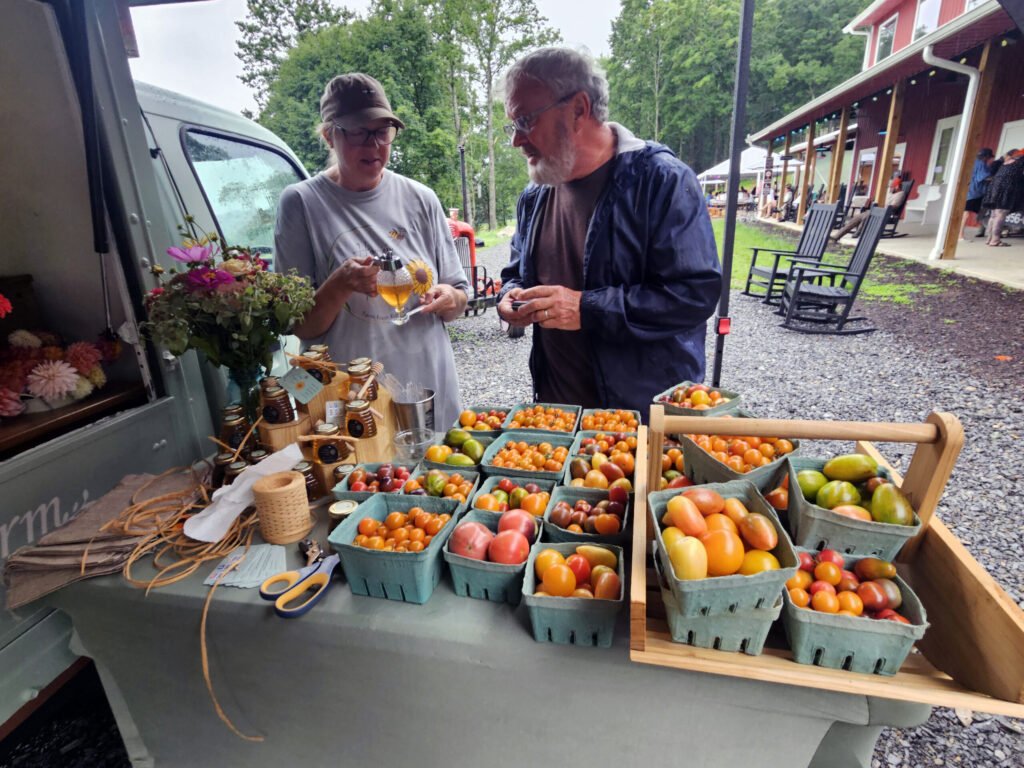
Jill O’Dell’s display at Honey Blossoms Farm was easy to find. Behind the table sat a pale green Japanese mini truck named Olive.
O’Dell farms in the Holston Valley area of Sullivan County, near South Holston Dam. She grows flowers, keeps honeybees, and harvests honey from the property several times a year.
Her market table also demonstrated how small farms frequently work together rather than in isolation.
Although many of the flowers were her own, O’Dell said she sometimes buys from other regional growers when she needs additional varieties or volume for an event.
“I also source from other local flower growers, especially if I have an event, so I can have a variety and more flowers,” she said.
The heirloom tomatoes at her table came from Persephone’s Farm and Gardens, another local grower that produces both flowers and wholesale tomatoes.
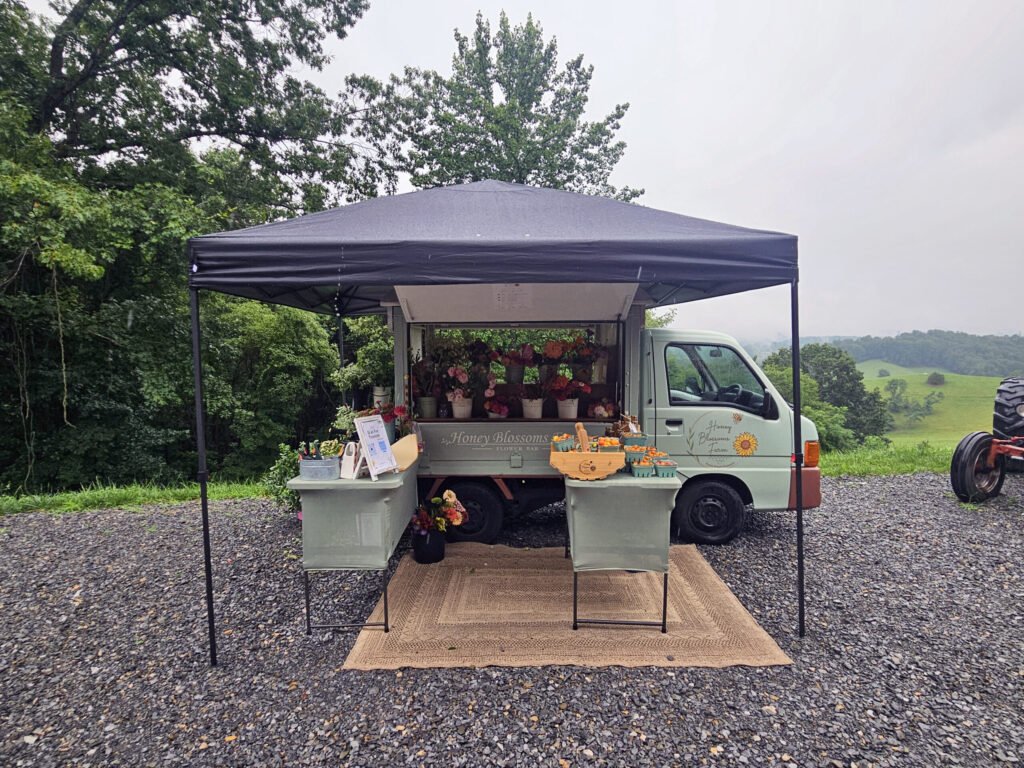
Then there was Olive.
The truck is a Subaru Sambar, a compact vehicle commonly used for agricultural work in Japan. Its enclosed rear box was fabricated there before the truck was imported. O’Dell later found it for sale on Facebook Marketplace.
She also owns a second Japanese mini truck without the box and uses it for work around the farm.
Olive is right-hand drive, which means O’Dell shifts gears with her left hand. The truck can reach roughly 50 mph, making it useful for local travel but not a vehicle for traveling on the interstate.
“It did take a little bit of getting used to,” she said of the left-handed shifting. “But I can drive it pretty much anywhere. It’s fun.”
The truck serves a practical purpose as a mobile flower bar, but it has also become part of Honey Blossoms Farm’s identity at regional markets.
Standing Pine’s Living-History Roots
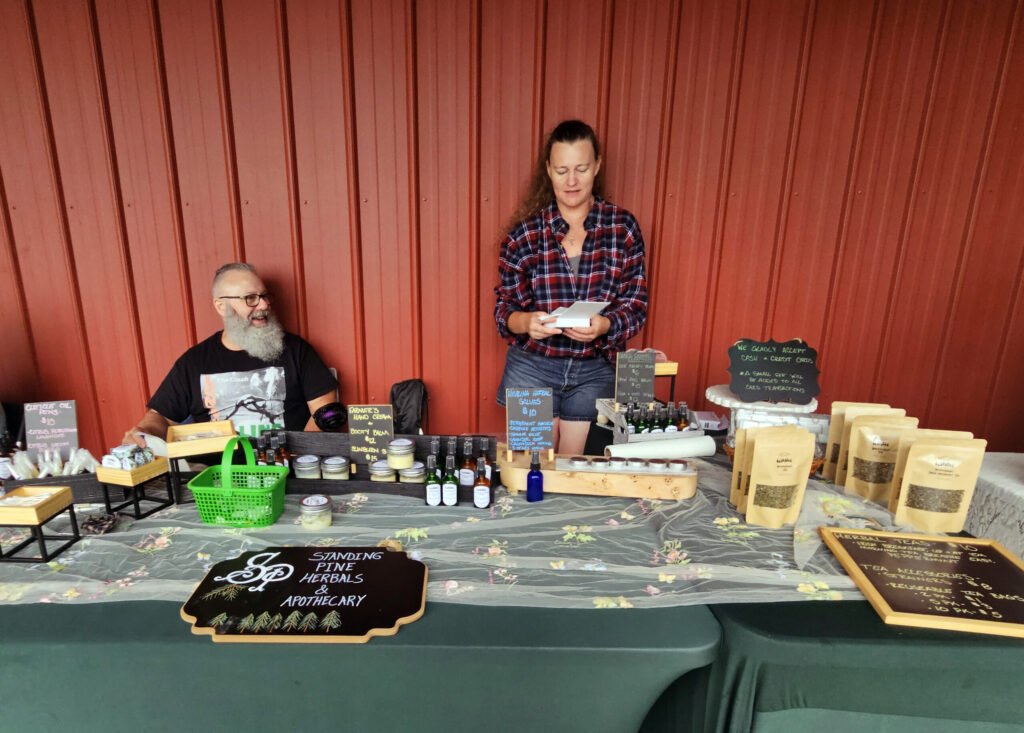
Rob and Whitney Hoss brought one of the market’s broadest product lines.
Standing Pine Herbals and Apothecary, based in Johnson City, sells herbal teas, salves, hand creams, beard oil, cuticle pens, lotion bars, insect repellents, and other personal-care products.
Rob offers an easy way to remember the spelling of their last name.
“Hoss, like Hoss Cartwright from the old TV show Bonanza,” he said.
The Hosses describe their ingredients as organic and non-GMO. Rob said the herbs they grow are cultivated with organic fertilizers and natural pest-control methods. The ingredients they purchase are sourced from suppliers that offer certified organic products, he said.
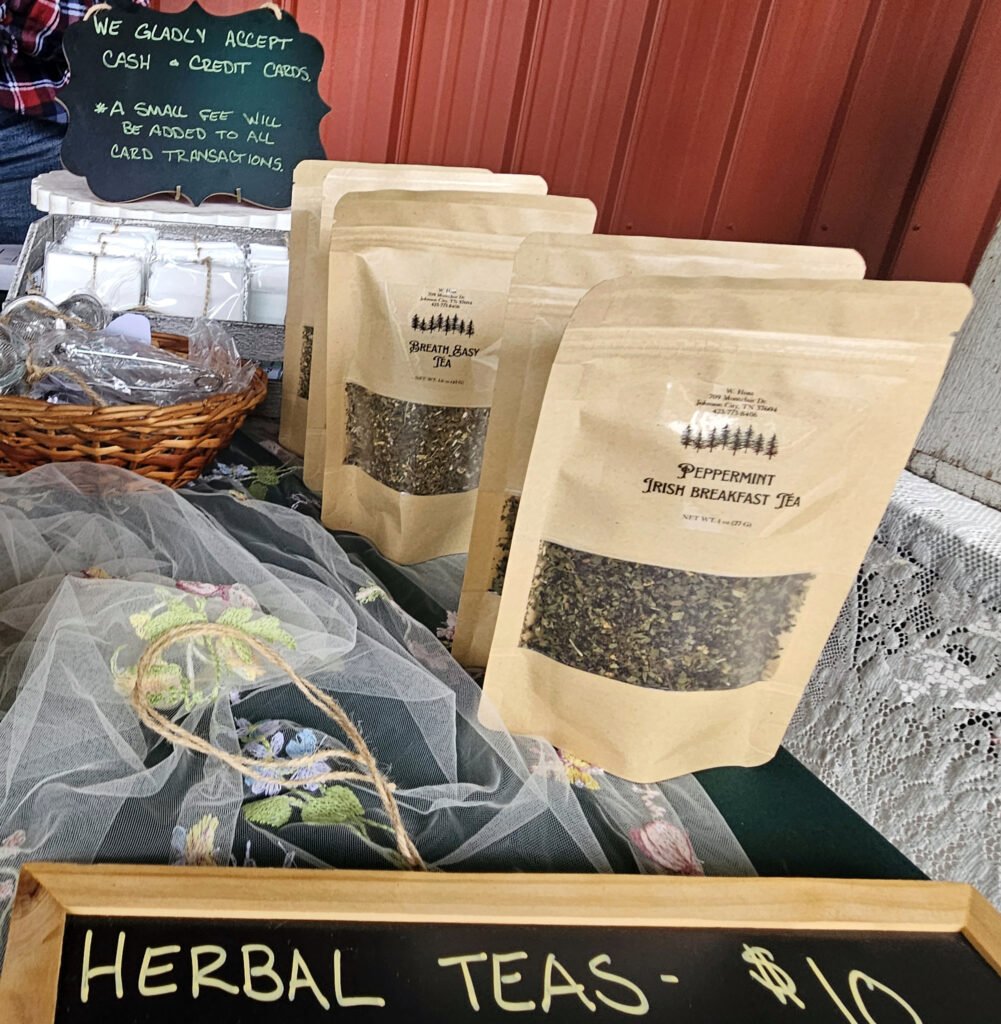
Their table included an herbal morning tea called Up and at’ Em, peppermint tea, and an Irish breakfast blend with peppermint. Rob makes beard oil, while Whitney has developed products including cuticle pens, hard lotion bars, and Farmer’s Hand Cream, made with ingredients such as shea butter, cocoa butter, and beeswax.
The couple’s interest in herbal products grew partly from another longstanding interest: living-history reenactment.
Rob and Whitney met 25 years ago through reenacting. Their family has participated in events interpreting periods ranging from the French and Indian War and the American Revolution to the Civil War, World War II, and the Vietnam War.
Spending long stretches in camps encouraged them to make products for their own household before offering them to others.
“We started this basically out of necessity, just for our own family,” Rob said. “We thought, hey, we’re already doing this for ourselves, and we do reenactment a lot. Why not start offering it to other folks?”
Their historical interests remain part of the family’s life. Rob is a retired kilt maker and has played the bagpipes for about 30 years. But at the farmers market, the focus remained on the teas, creams, and other products lined across the table.
Laurel Brooks Farm Grows in Several Places
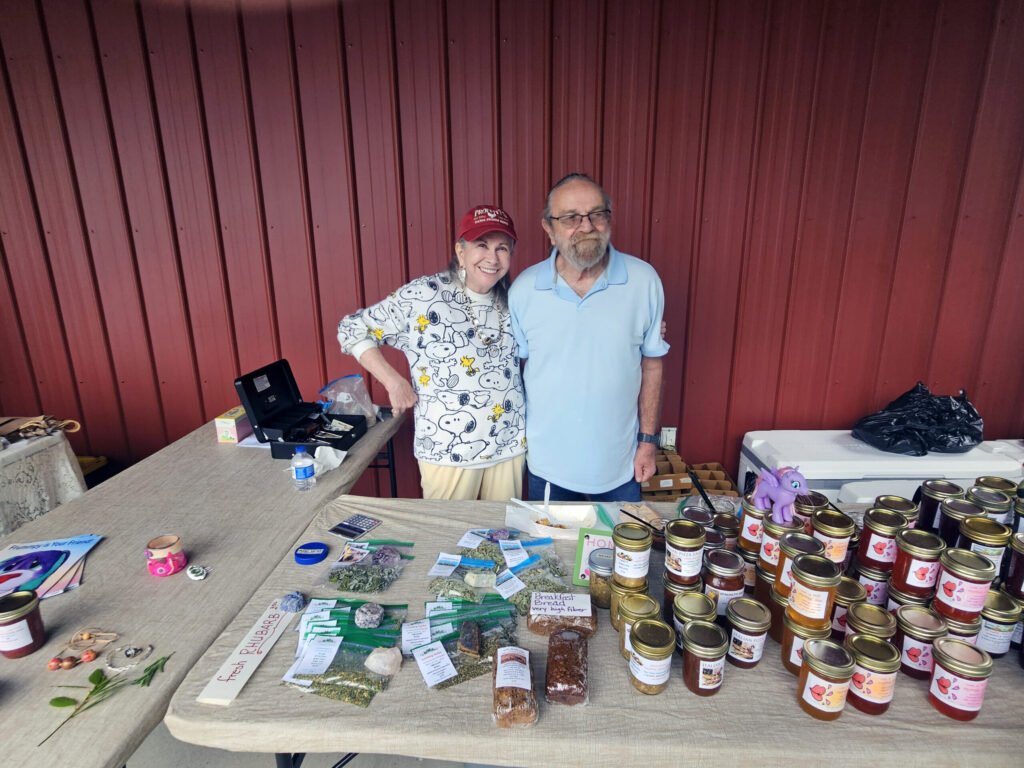
Sondra Alan describes herself with two professions that do not often appear together on a business card.
She is an attorney in Bristol. She is also a farmer.
Alan and Riley Proffitt were representing Laurel Brooks Farm, a 90-acre operation in Tazewell County. Much of their current growing, however, takes place closer to Bristol.
The farm also uses gardens at a country home in Washington County and a three-quarter-acre residential lot in the city. The Bristol property includes high tunnels, which have not pleased everyone in the neighborhood.
“Some of our neighbors aren’t so happy about the high tunnels in their area,” Alan said.
The unconventional setting has not discouraged her.
Alan said this was her “13th or 14th year doing the farmers market.”
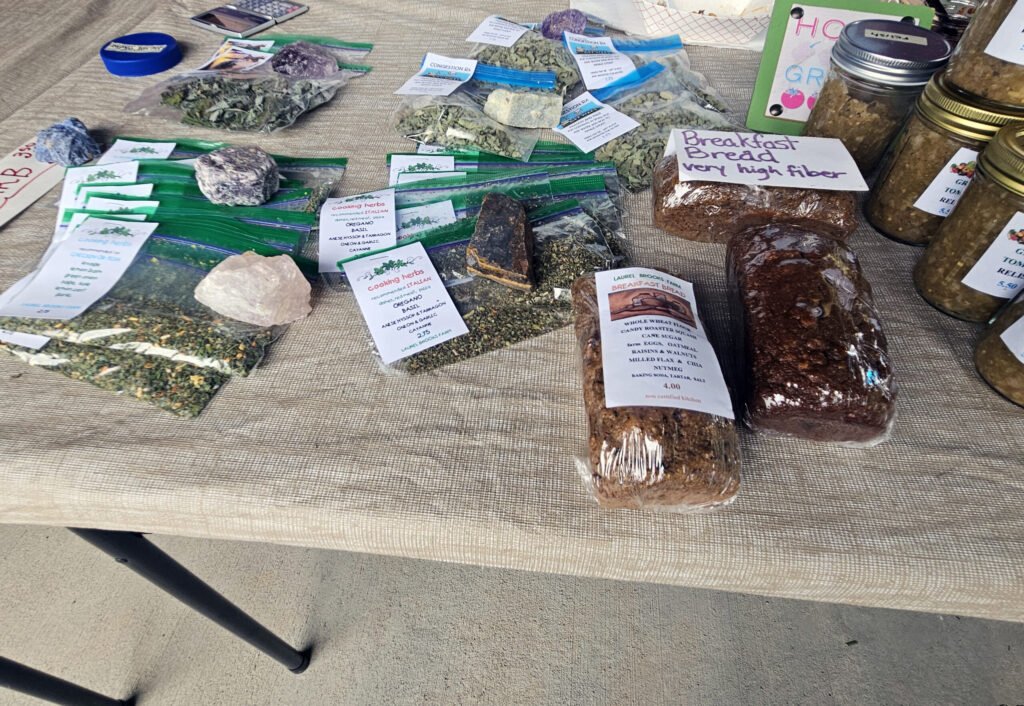
The Laurel Brooks table reflected the variety of its growing spaces. It held fresh culinary and medicinal herbs, breakfast breads, salsas, pepper jams, and other preserves.
The arrangement may be geographically scattered, but the products come together at the market: part Tazewell County farm, part Washington County garden, and part urban agriculture in Bristol.
Freda Horner Finds Texture Everywhere
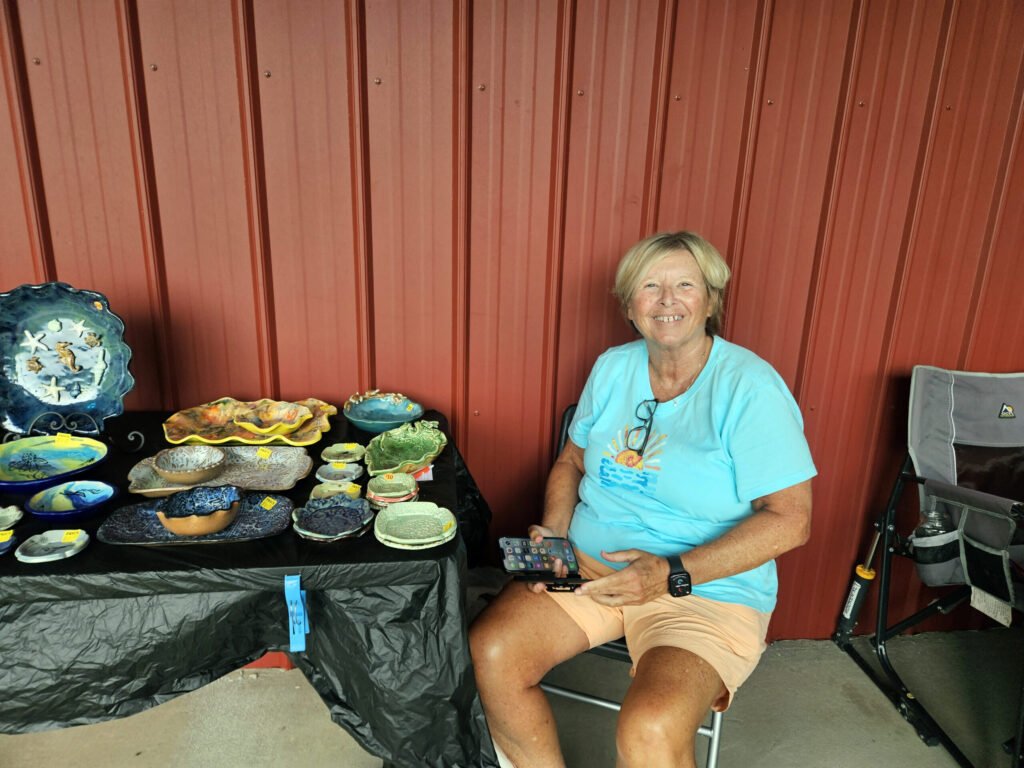
Freda Horner did not begin making pottery until after she retired in 2018.
It was something she had wanted to try for years. Retirement finally gave her the time.
“I had never done pottery, and I started,” Horner said. “I took a little class or two, and now I’ve got my own kiln at home.”
Her ceramics are hand-built rather than thrown on a wheel. She begins with a 25-pound block of clay, shapes the pieces, fires them, applies glaze, and fires them again.
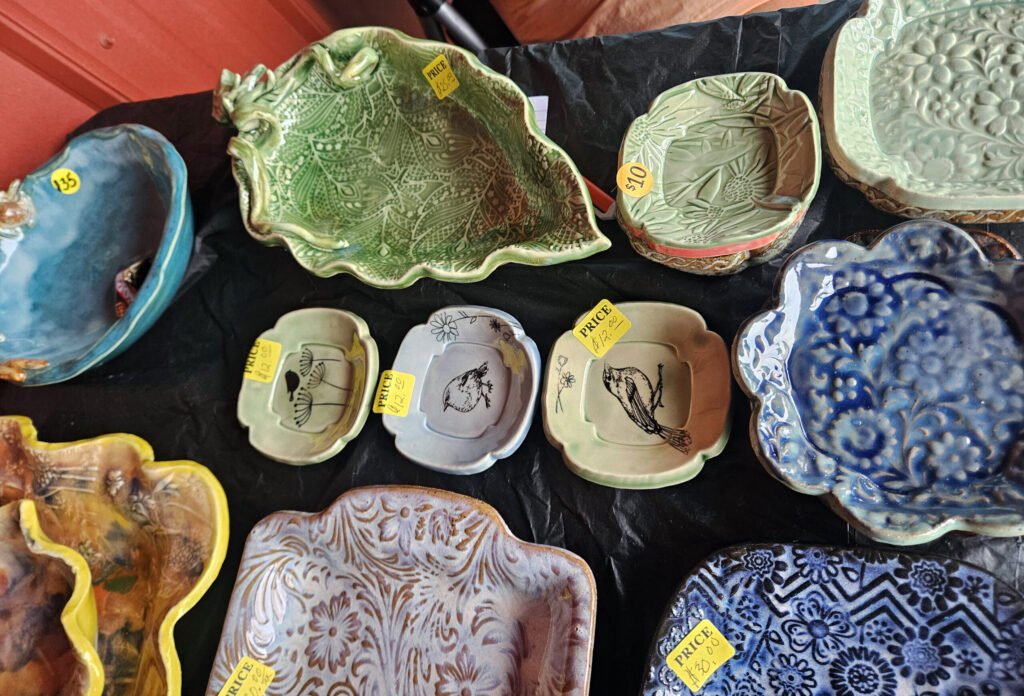
Texture is central to the work.
“A potter will look at anything as texture, from an onion sack to whatever,” she said.
Some patterns are pressed into the clay with wooden rollers. Others are painted freehand or carved with a tool. Her earlier experience with painting, including Bob Ross-style lessons, also influences the way she works with color.
One piece used several colors applied with a sponge over a layer of flux, allowing them to soften and blend during firing.
“It almost looks like a watercolor,” Horner said.
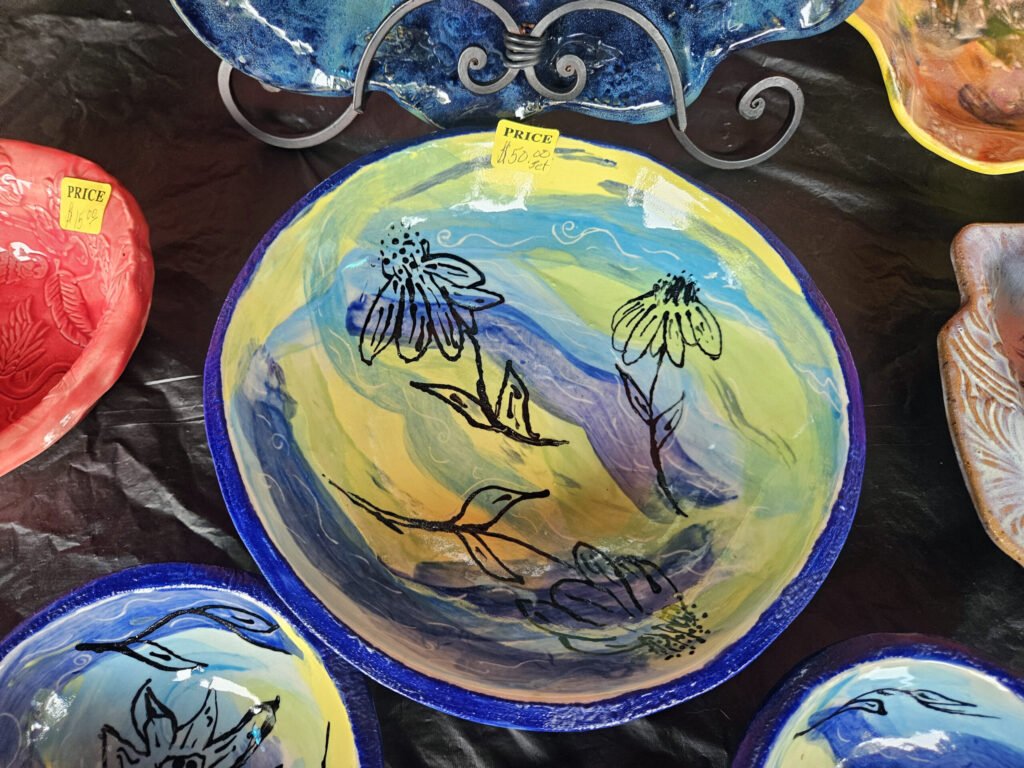
She also paints flowers by hand and creates white swirls by scraping into the surface before glazing.
Horner enjoys the unpredictability that remains after a piece enters the kiln.
“I love seeing how it turns out,” she said.
The market gives her something else she values: the chance to meet the people who stop to examine her work.
“That’s one of the best parts of the markets,” she said. “Talking to people.”
A Market That Stayed Open in the Rain
The rain continued through much of the Squabble State pop-up. Shoppers moved between the vendor canopies, the covered pavilion, and the cidery’s red-sided building while fog hung over the surrounding hills.
Squabble State provided more than a name for the event. Its gravel lot, covered gathering spaces, and mountain setting gave the vendors room to turn a wet Sunday into a market.
A separate article will take a closer look at Squabble State Hard Cider & Spirits, its cidermaking operation, and the plans for its 68-acre property.
On this Sunday, however, the attention belonged to the people beneath the canopies: cooks working over hot grills, farmers sharing one another’s harvests, families building businesses together, and artists explaining how a piece of clay begins with something as ordinary as the texture of an onion sack.
The rain kept falling.
The market kept going.










Leave a Reply